Faith-based nonprofits are in a paradox. You’re called to tremendous impact, but you’re fundraising in an era of intense change and competition. How do you stay true to what drew you to the mission of your nonprofit in the first place…while staying afloat in the age of AI, hyper-personalization, and shifting donor expectations?
There are 7 important fundraising shifts for faith-based nonprofits to track for the upcoming year. As we explore each shift, we’ll guide you through tactical next steps to feel confident in your fundraising while never compromising your values.
First, a Couple of Shout-Outs
At Virtuous, we offer the only AI-powered suite of Responsive Fundraising tools for faith-based nonprofits (and other nonprofits, too!). We had the privilege of attending and speaking at the Echo 2025 Conference, hosted by Missio Nexus, a network of churches and Christian mission organizations dedicated to advancing the Great Commission across North America.
While there, we spoke about our 2025 Faith-Based Nonprofit Benchmark Report…highlighting trends across 7 metrics for faith-based nonprofit organizations.
We also benefited from attending other sessions. We found that 2 sessions, in particular, complemented our own, so we wanted to start today by giving a shout-out to our sources!
All information in this blog is based on information from:
→ Strategic Fundraising Plan: Jon Delange & Evan Cox [1]
→ Sustainable Giving: Dave Raley [2]
→ The Virtuous 2025 Faith-Based Benchmark Report [3]
7 Important Fundraising Shifts That Matter for Faith-Based Nonprofits
1. Personalized Messaging is a Must-Have

The Trend
Strategic Fundraising Plan spoke about the duality faced by every faith-based nonprofit. Essentially, most faith-based nonprofits have two audiences:
→ The donors giving to their cause.
→ And the people they serve. [1]
And with these two separate audience groups, speaking directly to both audiences is where many faith-based nonprofits get tripped up.
In fact, most of the brands we know and love today focus on hyper-personalization: Netflix, Amazon, Spotify….all cater every message, recommendation, contact point to your last action.
How do faith-based nonprofits keep up?
Your Action Plan
Start with your message. It’s the connecting thread between your two worlds. The work you do and the people who make it possible. [1] When you clarify that message, you don’t need a bigger budget, new tech, or more staff to see results.
Remember that your audiences want different things. A donor may want to save lives and prevent disease, while the person you serve may simply want clean water and more time for their family. [1] The key is to speak to both without confusing either.
Build two complementary messages: one external for your donors and one internal for your staff and beneficiaries. When both audiences understand the same story from their own perspective, your mission becomes clearer, stronger, and more effective. Storytelling is the tool that makes this alignment possible. It helps everyone, inside and outside your organization, make sense of why your work matters. [1]
2. Recurring Giving Is Becoming the Standard
The Trend
The subscription economy has changed donor behavior. Nearly everyone pays monthly for something: streaming platforms, fitness apps, even groceries. This mindset is shaping generosity, too. Dave Raley of Sustainable Giving reported that 96% of Americans have at least one subscription, and more than half of Millennials prefer to give monthly over making one-time donations. [2]
Recurring donors are proving to be among the most reliable of supporters for faith-based nonprofits. They have retention rates as high as 86% and give 5-7x more over their lifetime. [2]
In fact, according to the 2025 Virtuous Faith-Based Nonprofit Benchmark Report, faith-based nonprofits already see about 16% of their total donation from recurring gifts, compared to lower averages in the general nonprofit sector. [3]
And if you think about it, that makes sense! Natural giving rhythms, such as tithes and regular offerings, are organically built into the mindset of many faith-based donors.
Your Action Plan
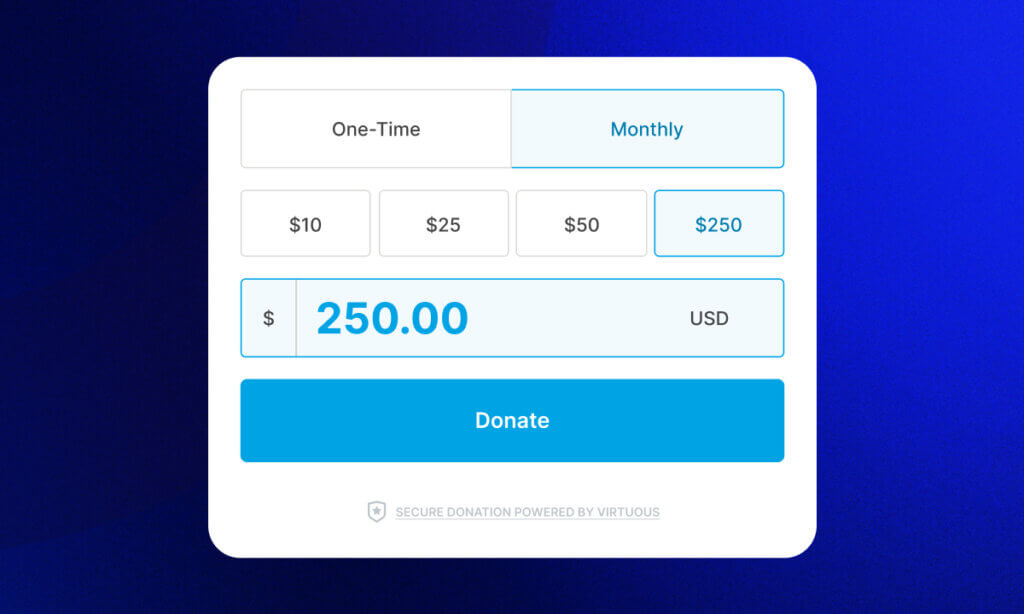
Encourage your supporters to become monthly donors. Instead of hiding “make it monthly” as a small checkbox, adjust your giving page to default to a monthly giving option with a smaller gift amount than the one-time gift suggestion. [2]
Make the recurring giving experience feel like an exclusive community. Share consistent updates, small thank-yous, and real stories of impact. Predictable giving helps both your donors and your organization plan for the long term with confidence. [3]
3. Donor Retention is a Worthy Investment
The Trend
Based on data from the 2025 Virtuous Faith-Based Nonprofit Benchmark Report, the average faith-based organization retains about 59% of its donors, outperforming the broader nonprofit average of 50%. [3]
In sharp contrast, faith-based nonprofits struggle in the area of donor acquisition, gaining new donors equal to 24% of their donor base, as opposed to 29% seen in the broader nonprofit sector.
Retained donors cost less to cultivate, stay engaged longer, and are more likely to advocate for your mission. While acquisition is still important, focusing too heavily on growth can pull attention away from deepening relationships with the people already supporting your cause. [3]
Your Action Plan
Shift part of your fundraising energy toward retention. Track engagement points like email opens, event attendance, and recurring gifts.
Find ways to make your current supporters feel seen and appreciated. Send a personalized thank-you message, spotlight loyal donors in your communications, and regularly show the results their giving makes possible. [3] A donor who feels known will give longer and tell others why your work matters.
4. The Second Gift Matters

The Trend
Faith-based nonprofits excel at meeting supporters in moments of generosity. But lasting impact comes not just from the first gift; it grows when we intentionally cultivate the second gift. More specifically, how many days pass between that first gift and the second gift.
The average time between a first and second gift for faith-based nonprofits is 117 days. [3] That time window represents a critical opportunity for faith-based nonprofits to build trust and demonstrate real connection.
Organizations that wait too long to re-engage first-time donors often lose them. The most resilient faith-based nonprofit organizations are developing systems to nurture new supporters right away, before they slip into inactivity. [3]
Your Action Plan
Using automation workflows in Virtuous CRM+, you can schedule a “second touch” sequence after every supporter’s first gift. A personal email, a phone call, or a short video message can make a lasting impression. Celebrate the first gift, show the impact it made, and remind the donor how their ongoing support will continue to make a difference. [3]
Treat that second gift as the true beginning of the relationship. This moment sets the tone for long-term generosity and turns casual givers into faithful ministry partners.
5. Technology (and AI) Works Best as a Stewardship Tool

The Trend
Especially with new developments in artificial intelligence, every organization is looking to technology to save time, attract donors, and simplify giving.
But new software and tools do not guarantee better results. It’s important to keep a healthy mindset around technology and AI, remembering that it should serve strategy, not replace it. [2]
Faith-based nonprofits that thrive with digital tools are using them to deepen connection, not distance it.
One example of this is Virtuous Momentum, an AI agent that fundraisers can train to write donor emails in their own voice. Using smart suggestions, Virtuous Momentum delivers a daily schedule of outreach prioritizations.
Then, it drafts personalized emails to those donors, ready for edits and approval from the fundraiser behind it all. As fuel for those emails, Virtuous Momentum uses context from previous engagements with this donor, all to enhance personalization.
AI advancements in fundraising, such as Virtuous Momentum, represent an example of ways to harness the power of AI to make fundraising feel even more human. Using it as a time-saving stewardship tool but not totally replacing the prayerful, personal touch behind the work.
The key is keeping the relationship at the center of every tool you use. [2]
See Virtuous Momentum in action.
Your Action Plan
Before rushing to adopt the newest tools or AI platforms, take time to set clear boundaries for how your organization will use them. Developing an AI policy helps ensure technology supports your mission rather than reshapes it.
An AI policy should serve as a living framework that evolves as both your ministry and technology change. Begin by gathering input from multiple perspectives: leadership, fundraisers, program staff, and tech experts. This team can identify where AI will help and where it could unintentionally create risk.
Your policy should cover areas such as ethics, privacy, fairness, accountability, and mission alignment. It should also outline how your organization will monitor AI performance, prevent bias, and maintain human oversight in all donor interactions.
When AI is guided by thoughtful policy, it becomes a trustworthy assistant rather than an untested experiment. Used wisely, tools like fundraising automation and personalized outreach can save time and enhance stewardship, without compromising the relational integrity that defines faith-based work.
Start by writing down your organization’s values around AI and technology. Then, review them regularly to make sure every new tool you add continues to serve people, purpose, and the your overall mission[2]
6. Use Data as a Relationship Connection Tool
The Trend
Faith-based organizations are beginning to see data as more than accounting. Metrics like donor retention, average gift size, and lifetime value reveal the health of relationships as much as they do financial performance. [3]
The most resilient ministries are measuring not to control outcomes, but to understand them. When tracked over time, donor data can highlight which messages resonate, which touchpoints lead to repeat giving, and where connections are fading. [3]
Your Action Plan
Using the Virtuous 2025 Faith-Based Benchmark Report, you can get a pulse on the health of your nonprofit vs. other faith-based nonprofits.
In our 2025 report, we include data from 143 faith-based nonprofits, who all shared their data across 7 important fundraising metrics. Faith-based nonprofit organizations are using this report to compare their current data to the averages revealed in this report.
Included in the report are actionable next steps for any concerning areas, so this can be used as a health assessment and a playbook for your nonprofit.
→ Download the Benchmark Report now.
7. Alignment Inside the Organization Fuels External Impact
The Trend
Many ministries struggle to keep communication consistent across departments. Program staff often focus on operations and outcomes, while fundraisers prioritize storytelling and connection. [1] This difference in priorities can lead to confusion, missed opportunities, and inconsistent messaging.
When all teams share a unified understanding of the mission and communicate from the same story, both staff morale and donor trust improve. [1]
Your Action Plan
Create regular moments for alignment. Bring program, marketing, and fundraising teams together each quarter to review key messages and campaign goals. [1]
Encourage open communication about language, priorities, and shared wins. A unified story not only strengthens internal collaboration but also creates a clearer, more consistent experience for every donor and partner who interacts with your organization. [1]
Where to Get Started: How to Address These 7 Shifts
When your mission is eternal, but your fundraising reality changes fast, it’s easy to feel stuck. You’re expected to deliver more personalized messaging, grow recurring giving, retain donors, and adopt new tools…all without losing the soul of your ministry.
Virtuous CRM+ is built for this tension.
When your job is to:
→ Turn one-time supporters into consistent monthly givers
→ Shorten the time to second gifts
→ Keep more donors year over year
→ Automate stewardship without losing authenticity
→ Align fundraising, programs, and marketing with a shared message
→ Use data not just to report, but to build deeper relationships
Virtuous CRM+ gives you the responsive tools to do it.
Pre-built automation, embedded donor insights, and AI-powered tools like Virtuous Momentum help you:
→ Personalize donor journeys
→ Trigger second gift touchpoints
→ Recover failed recurring gifts
→ Create campaigns tailored to giving behavior and spiritual values
vStrengthen internal alignment across teams
All while saving time and building real trust.
See how it works for your ministry.
→ Schedule a personalized demo of Virtuous CRM+
Start building a fundraising program that’s responsive, rooted, and ready for the future.
Sources:
[1] https://strategicfundraisingplan.com/
[2] https://www.sustainablegiving.org/
[3] https://virtuous.org/resource/faith-based-nonprofit-benchmarks-2025/