Suggested Donation Amount TL;DR:
- Personalize your suggested donation amount. Don’t guess. A generic suggested donation amount sent to your whole file signals you don’t know your donor, and it costs real revenue.
- Start with data you already have. Average gift size, most common gift amount, and first-time vs. returning splits from your CRM are the fastest starting point, before any AI or persona work.
- Match the format to the donor. Gift arrays work for most donors; major donors respond better to open-ended asks.
- Ask for more than you think. Most nonprofits underask by a wide margin; personalized amounts average a 29% lift in gift size versus a flat 4.5% for generic asks. [1]
- Pair the number with impact. It means more to a donor when they can see exactly what it funds.
- Treat it as ongoing, not one-time. Revisit and test your ask amounts at least once or twice a year as giving patterns shift.
Fundraising appeals may seem simple, but there’s a lot of thought that goes into deciding the right suggested donation amount to include. It might even seem like there’s never a perfect answer to “How much should we ask for?”
Ask for too much, and the donor might feel like they can’t make an impact with their gift.
Ask for too little, and you’re leaving giving potential on the table.
Add that “what-should-we-ask-for” problem to a fundraising environment that changes by the minute, and it’s easy to see why so many nonprofits default to a flat, guessed number instead of a real strategy.
At Virtuous, we believe nonprofits deserve access to both the data and the technology to master the art of proposing a suggested donation amount that lands with each and every donor. In this post, we’ll also break down 9 genuinely helpful guidelines to follow…what actually works, and where donor data and AI now do a lot of that thinking for you.
9 Best Guidelines for Setting the Right Suggested Donation Amount
There’s no universal formula, but donor research and behavior point to a few patterns that quietly cost nonprofits real generosity every year.
1. Avoid a Generic Suggested Donation Amount Whenever Possible
The traditional playbook, mass emails, generic giving levels, one-size-fits-all appeals, doesn’t work on donors who are used to personalized experiences from every other brand they interact with. They notice when they’re treated like a name on a mailing list instead of a person, and a flat suggested donation amount sent to the entire file is one of the fastest ways to send that signal.
Responsive fundraising exists to fix this: using donor data to listen, connect personally, suggest the right next step, and learn from what happens. The number you land on is one of the clearest places that shows up, since it’s the single figure that tells a donor whether you actually know them.
2. Start With the Data You Already Have
Before segmenting donors into personas or modeling anything with AI, the fastest starting point is inside your own CRM. Here are some stats you should know:
Average Gift Size
It always helps to know the average gift size across your file and by campaign. Your default suggested donation amount should sit near this number, not above or below it by a wide margin.
According to our 2026 Nonprofit Benchmark Report, the average nonprofit gift amount in 2026 is $136, and top-quartile organizations are averaging $516.
Median Gift Amount
It’s also worth looking at your median gift, the gift sitting at the exact midpoint of your file, separate from the average. Because it’s unaffected by a handful of large donations pulling the number up, median gift gives you an honest read on what your everyday donor is actually giving, not what a few major gifts make it look like they’re giving.
Based on data from our 2026 Nonprofit Benchmark Report, the overall median gift in 2026 is $50, and top-quartile organizations are seeing a median of $103. The median also climbed nearly 20% year over year, a signal that growth is happening across the broad middle of the donor file, not just at the top. When median outpaces average, that’s usually a healthier trend than it looks at first glance.
Most Common Gift Amount
Most common gift amount is the specific dollar figure that shows up more often than any other in your file, usually because it’s a preset option on your donation form. It’s a different signal than average or median: instead of describing the center of your distribution, it tells you exactly where donors land when you hand them a menu of choices.
If $50 turns out to be your most common gift and your form doesn’t even offer $50 as a preset amount, that’s a gap worth closing before you touch anything else.
First-time vs. Returning Donor Split
First-time vs. returning donor split matters because a donor’s first gift and their fifth gift are answering two different questions:
- One is testing the relationship.
- The other is confirming it.
Per the 2026 Nonprofit Benchmark Report, first-to-second gift conversion sits at just 25.84%, meaning roughly three out of four first-time donors never make it to a second gift at all. That’s the group a flat, one-size-fits-all suggested donation amount is most likely to lose, and exactly the group worth treating differently on purpose.
3. Gift Arrays Aren’t a One-Size-Fits-All Suggested Donation Amount Strategy
For direct mail appeals, there are two main formats: open-ended pledge cards and gift arrays. In a webinar we participated in with AskGenius, we explored the research: Gift arrays work well for most donors, but not for major donors, who should get open-ended cards instead. [1]
The psychology makes sense. A major donor doesn’t feel especially generous checking a pre-filled box. They want to arrive at a number themselves and write it down. For every other donor, a well-built gift array works, as long as it’s personalized to that donor’s own gift history and capacity rather than a generic number sent to the whole list.
Building that array by hand for every segment stops scaling past a certain list size.
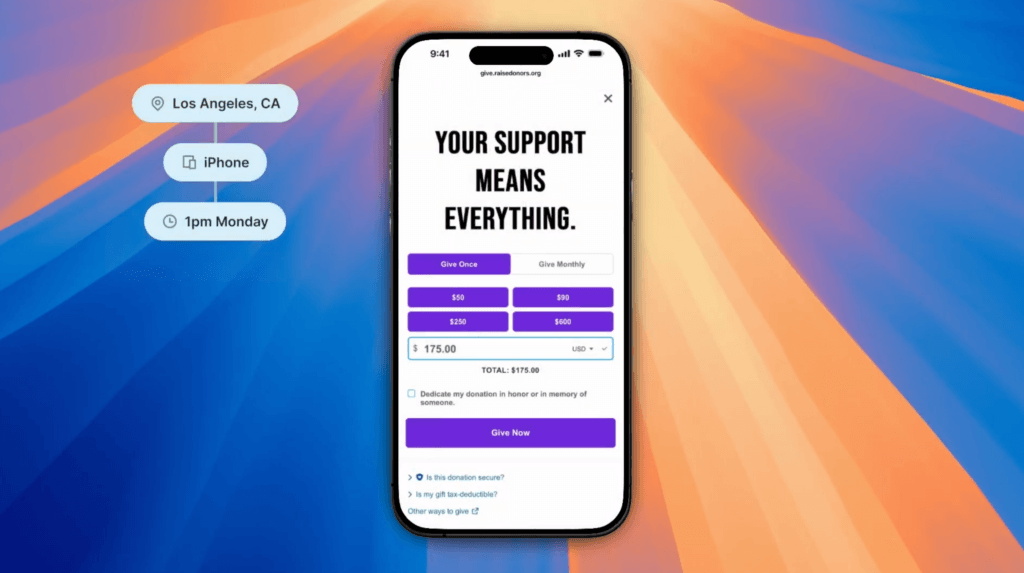
In Virtuous Raise, our online giving platform, we empower nonprofits with Responsive Ask Arrays to solve exactly this. Raise generates each donor’s gift array directly from their own giving history on the donation form, with a static fallback for donors without enough history to model.
Learn more about our Responsive Ask Arrays in the video below.
How to Order Your Suggested Donation Amount Options
Display order matters more than most nonprofits assume. It’s tempting to list gift array amounts high to low, but research on donor response found low to high converts 17% more gifts. [1]
The reasoning: if the first number shown is out of reach, the donor has to scroll down the list until they find something feasible, and every step down chips away at how much impact they feel their gift will have. At worst, they give up entirely before finding a number that fits. The same principle applies to how a donation page is laid out overall; order and framing shape the gift as much as the number does.
4. Personalized Suggested Donation Amounts Convert Better Than Generic Ones
There’s no single formula that fits every donor profile, and sending everyone the same ask amount creates an impersonal experience that costs real revenue.
The numbers make the case directly. Sending everyone the same ask amount tends to produce roughly a 4.5% increase in giving year over year, which is about what inflation alone would predict. [1] Personalized ask amounts, by contrast, average a 29% increase in gift size. [1] That gap is the entire argument for personalizing the ask instead of treating the donor file as one group.
Virtuous Insights, our prospect research tool, takes a donor’s giving history, engagement data, and third-party wealth intelligence and turns it into a specific suggested donation amount, along with an annual giving potential range for that donor. For higher-value donors, it can also recommend an open-ended ask instead of a fixed amount when that approach offers more flexibility. The result is actionable gift guidance your team can use immediately, not just another score that still leaves the ask amount up to guesswork.
You can get a demo of Virtuous Insights HERE to see this in action.
5. Don’t Undersell Your Suggested Donation Amount
The most common upgrade tactic, bumping the ask by a flat 10%, only works on roughly one in five donors and leaves real generosity on the table for the other four.
Most nonprofits simply aren’t asking for enough. Donor research suggests a firmer approach: moderate to aggressive increases in the 10% to 50% range for major donors, and 25% to as much as 1,150% for everyone else, depending on the donor’s actual giving trajectory, not a flat across-the-board bump. [1]
6. Even Small-Gift Donors Can Support a Higher Suggested Donation Amount
It’s easy to assume a donor’s past gift size is their ceiling. If two donors have both given $100, one might genuinely be maxed out, while the other could be ten times more capable and simply hasn’t been asked properly yet.
Wealth screening exists specifically to catch that second donor before you underask them for years. There’s a wide range of wealth screening software on the market, and pairing it with strong prospect research habits, or with Insights’ own wealth and capacity modeling, is what turns a guess into a number you can actually stand behind.
7. Pair Every Suggested Donation Amount With a Clear Impact Statement
A number by itself doesn’t tell a donor much. Showing what that number actually funds does. A $50 gift that “provides five meals” or a $500 gift that “sponsors a family for a month” gives a donor a reason to pick the higher end of the array instead of defaulting to the smallest option out of habit.
This works best when the impact statement changes with the suggested donation amount rather than repeating the same generic tagline under every option.
Donation forms built with full creative control, the kind Virtuous Raise is built around, make it possible to attach a distinct, specific impact line to each amount instead of settling for one blanket sentence at the bottom of the form.
8. Test and Refine Your Suggested Donation Amount Over Time
A suggested donation amount isn’t a one-time decision. Giving patterns shift by season, by campaign, and as your donor file grows or ages, and an array that converted well last year can quietly underperform this year without anyone noticing.
Revisit the data behind your suggested donation amount at least once or twice a year, average gift size, most common amount, and response rate by segment, and adjust from there.
Raise’s A/B testing capability is built to make this an ongoing habit rather than a once-a-year scramble, testing amounts and arrays against real donor response instead of a hunch.
9. Use AI to Inform Your Suggested Donation Amount
Connect your donor data
Start by connecting the donor data you already have. Virtuous Insights (available within Virtuous CRM+) combines first-party CRM and digital signals with third-party wealth and demographic data in one place, so gift history, engagement, and donor context can all inform the ask instead of living in separate systems.
Let Insights generate the suggested amount
From there, Insights helps your team move from interpretation to action. It uses predictive machine learning to surface AI-suggested ask amounts and timing, plus recommended gift ranges based on each donor’s capacity, so fundraisers are not left staring at a wealth score and guessing at the number themselves.
Put it directly on the giving form
Virtuous Raise carries that intelligence onto the giving form. For known donors, Responsive Ask Arrays can use CRM history, including Virtuous Suggested Amount, Average Gift Amount, or Last Gift Amount, to personalize the array automatically.
Let AI cover the donors your CRM doesn’t know yet
For unknown donors, Raise uses AI-powered ask arrays informed by signals like location, device, timing, and organization-level giving behavior, so even first-time visitors are more likely to see amounts that feel realistic and relevant.
The end result is less manual guesswork, more relevant suggested donation amounts, and a process your team can apply at scale instead of rebuilding by hand for every appeal.
Putting Your Suggested Donation Amount Into Practice
None of this has to happen at once. Start with the data you already have, sort donors into rough segments, fix the format before the number, and add impact statements where you can, in whatever order fits your team’s bandwidth.
The nonprofits that get the most out of this aren’t the ones with the most sophisticated model. They’re the ones who actually go back and check whether last year’s suggested donation amount still matches this year’s donor.
Not fancier. Just current.
Fundraising Ask FAQs
What is a fundraising ask?
A fundraising ask is the specific amount, or range of amounts, a nonprofit requests from a donor in an appeal, email, or donation form. How well a fundraising ask performs comes down almost entirely to how closely the suggested donation amount matches what that specific donor can and wants to give, not the wording around it.
What’s a good suggested donation amount to start with?
There’s no universal number. A good suggested donation amount reflects a donor’s own giving history and capacity, not a flat, org-wide default. That’s the entire argument behind personalized ask strings and tools like Insights’ gift-suggestion modeling: the right amount for a first-time $25 donor and a lapsed major donor who once gave $5,000 are not the same amount, and shouldn’t be treated like they are.
What’s a soft ask, and how is it different from a suggested donation amount?
A soft ask invites engagement, volunteering, sharing a campaign, showing up to an event, without asking for money directly. It’s often used before or alongside a suggested donation amount, especially for donors who haven’t given recently, to warm the relationship up before a direct fundraising ask.
How often should you ask donors for more money?
There’s no fixed cadence that works across an entire donor file. What matters more than frequency is whether each fundraising ask reflects an actual change in the relationship, a new gift, a new form of engagement, a new capacity signal, rather than repeating the same suggested donation amount on a schedule regardless of what’s changed.
When should you increase the ask amount for a donor?
The clearest signal is a shift in the relationship: a donor who moved from occasional to monthly giving, showed up to an event, or revealed new capacity through a major gift elsewhere. Increasing the suggested donation amount without one of those signals mostly just increases the odds they say no.
How does Virtuous help set a suggested donation amount?
Virtuous Insights models a donor’s giving capacity from their history, wealth signals, and engagement data, and hands fundraisers a specific gift suggestion instead of a wealth score to interpret manually. Virtuous Raise is piloting Responsive Ask Arrays to apply that same modeling directly on the donation form, along with A/B testing to refine it over time.
Sources
[1] https://askgenius.com/webinar/how-much-should-you-ask-for/