Changing the question that starts the work
The question arrived quietly. No theatrics. No new software demo glowing on a big screen. Just a director of programs looking at a whiteboard that had seen too many budget seasons and saying to herself, “How can AI help?”
It’s the kind of question that signals a shift–the moment an organization stops seeing AI as a novelty and starts seeing it as the key to overcoming barriers that once felt fixed. Too expensive. Not practical. Simply impossible. Those limits are crumbling now.
It changed the temperature in the room. Plans paused mid-sentence.
A veteran fundraiser uncrossed his arms.
The CFO, who had come prepared to say no to three worthy projects in a row, looked up as if a new door had opened behind the one everyone kept pushing on.
The moment didn’t feel technical. It felt humane–like someone had remembered an old truth about this work: Imagination almost always arrives before resources.
Five years earlier, the same question might have sounded like a detour. Today, it was the center line. Not because the organization had become a different kind of institution, but because it had trained a different kind of first instinct. Call it muscle memory. Call it a compass setting.
Either way, it had begun to ask a better opening question: “How can AI help?”. And that question changed what came next.
For nonprofits willing to think AI-first, this is the question they’re embracing…first. And the path to amplifying their mission has never been more open.
AI-first nonprofits are organizations who treat artificial intelligence as a foundational lens, one that informs how they deliver their mission and expand their impact from the inside out. It is a mindset that places the potential of AI at the beginning of the strategy, not the end.
In this article, I’ll explore the 6 powerful principles your nonprofit can implement to become an AI-first nonprofit.
1) AI-First Begins With Design, Not Constraint
2) AI-First Uses AI to Build Trust & Connection
3) AI-First Delivers Timely, Practical Help
4) AI-First Starts With Instinct & Curiosity
5) AI-First Builds With Discernment, Not Hype
6) AI-First Measures What Matters Most
Now, let’s take a look at each one in more detail.
1. AI-First Begins With Design, Not Constraint
The staff didn’t reach for a trendy tool. They reached for a clearer design. If their goal was to serve more people without burning out the team, then the plan would start where scale begins: in the design of the work itself.
That meant asking what could be predicted, what could be personalized, what could be automated—and where only a human voice would do.
The story that followed was not about saving time. It was about spending time on the parts of the mission that are irreducibly human.
Across town, another organization was waking up to the same shift. A small arts nonprofit that never had the luxury of a full-time data team learned to build prototypes in a week instead of a quarter. They didn’t wait on a distant technical queue. They sketched with AI-first–audience research in hours, multilingual copy overnight, and segmentation that actually matched the way their neighbors move through a city. Ticket sales rose, but the more interesting metric lived on another axis: people who had never felt invited were suddenly walking through the door.

If this sounds like a change in culture, it is.
But it is also a change in story.
For decades, nonprofits have taught themselves to start with constraint. The AI-first nonprofit starts with design. The difference is not cosmetic. It is philosophical.
Begin with constraint, and you will squeeze a plan into whatever time and talent remain.
Begin with design, and you will reimagine the work so that constraint has less power over it.
2. AI-First Uses AI to Build Trust & Connection

In the for-profit sector, this shift has already happened in plain sight. When Google told the world it was becoming an AI-first company, it wasn’t promising a feature. It was announcing a lens. You could see it in the way search evolved, in the way assistance moved from a product to a layer, and in how machine learning became a way to think rather than a discrete department.
Nonprofits, though, aren’t chasing market share. They’re chasing something harder to count–trust, connection, a better Tuesday for someone who’s learned to expect worse. Which is exactly why this lens matters more here.
When your mission is to reach many without losing anyone, you need personalization without pretense, prediction without arrogance, automation that amplifies care rather than replacing it.
AI-first is not a luxury mindset for this work.
It is one of the few ways to scale intimacy.
3. AI-First Delivers Timely, Practical Help
I think of a refugee family at a municipal office, where language can be a wall that shrinks the room. Years ago, a translation service would have meant a long wait, an awkward call, a stranger on speakerphone. Today, a network of human interpreters and AI systems stand up a bridge in minutes, across dozens of languages and dialects, with privacy handled as a requirement, not an afterthought. The numbers tell part of the story–hundreds of thousands helped each year–but what stays with you is the face on the other side of the table when they realize they have been heard in their own words.

Or consider work that once exhausted whole teams. Years of satellite images, where a single analyst would scan footage for signs of a burned village, a road cut, a river crossing turned into a risk. Human rights researchers began to pair human review with machine learning models that learned to flag patterns quickly. What took weeks became hours–not for efficiency’s sake, but so evidence could arrive in time to protect someone.
If you want another register entirely, look at maternal health. Predictive approaches can shift a program from hoping to hit the mark to knowing where the risk is highest before harm arrives.
Data stops being a year-end report and becomes a map on Monday morning. Yes, bias and blind spots exist. But the most interesting work treats those risks as design limitations, not reasons to abandon the design.
4. AI-First Starts With Instinct & Curiosity

None of this works if leaders treat AI like a seasoning sprinkled at the end. The AI-first nonprofit does something more subtle. It cultivates a first instinct across the organization.
A program manager asks, “What could we automate without losing the soul of the work?”
A development officer asks, “Where could prediction let us show up before a donor asks?”
A volunteer coordinator asks, “How do we match skills to needs in real time so people feel useful on day one?”
At Virtuous, we’ve been intentional about making that instinct part of our own DNA. Moving into an AI-first mindset means every person–whether in engineering, customer success, marketing, or product–is empowered to be curious and to ask, “How can AI help accelerate and amplify the mission of the organizations we serve?”
This isn’t an abstract value. It’s how we open planning meetings, design new features, and measure success. The result is not only better tools, but deeper alignment with the missions our customers champion.
5. AI-First Builds With Discernment, Not Hype

AI-first does not mean AI everywhere. It means asking better questions at the beginning:
- Where are the stakes high enough that a person must decide?
- What data do we have no right to collect?
- Which labels in our systems have become lazy proxies for power?
- What is the smallest model we could use and still earn the outcome we want?
The temptation will be to chase the newest model. The discipline will be to remember that the model is not the mission.
When leaders adopt AI-first, they aren’t just buying tools. They’re building architecture—the kind that sets the rules for how work gets done. And the best architecture pairs ambition with humility. Ambition without humility becomes theater. Humility without ambition becomes maintenance. The AI-first nonprofit needs neither.
It needs stewardship with a designer’s eye.
6. AI-First Measures What Matters Most

There is a passage in nearly every nonprofit’s history where a funder asked for outcomes, and the team–with the best intentions–built only what they could measure.
AI-first can make the opposite possible. Build what matters. Then, ask AI to help you measure more of it, more honestly, with more context.
This is what smart capital should be buying in the next decade–the organizational capacity to work this way. It is as leveraged as any philanthropic dollar can be. It buys the conditions where people do their best work. The business press has begun to name this explicitly. But the sector has always known it in its bones: capacity is how you multiply impact.
Wrapping Up: AI-First Is a Practice, Not a Finish Line
The rest is practice. Practice noticing where your teams reach for the old way because it feels safe.
- Practice asking the better question before the calendar fills.
- Practice inviting funders into the architecture, not just the ribbon-cutting.
- Practice writing governance that reads like values in action, not legal insurance.
- And celebrate the small wins that feel like the future arriving on a Tuesday.
If you want a reason to start now, look around. You will see nonprofits already building with AI at the foundation–translation networks moving with human and machine in tandem, human rights labs spotting patterns in the sky, maternal health programs finding risk before it finds a mother.
Any “best practice” forged before the release of ChatGPT belongs in a museum, not your strategic plan. The missions that thrive in the next decade will be led by people bold enough to assume anything is possible and to rethink everything.
The cover story I want to read 10 years from now is not about disruption. It is about attention. It is about nonprofits that multiplied human attention across a field too large for manual care alone. It is about leaders who rewrote their first instinct and, in doing so, rewrote their results. It is about a sector that remembered technology is not the end of our work: It is one of the few ways left to make our work as generous as our ambitions.
And it starts, still, with the quiet question that changes the room:
“How can AI help?”
If you find yourself asking that question, Virtuous can help.
As an AI-powered CRM+, Virtuous doesn’t just help you manage data. We help you multiply attention, reduce organizational drag, and architect responsive systems that scale intimacy, not inefficiency.
For nonprofits willing to think differently, Virtuous offers more than software. It’s a strategy shift. Because responsive fundraising doesn’t start with constraint. It starts with design. And that design should be powered by tools that treat generosity like the transformative force it is.
See how Virtuous equips AI-first nonprofits to lead with imagination.
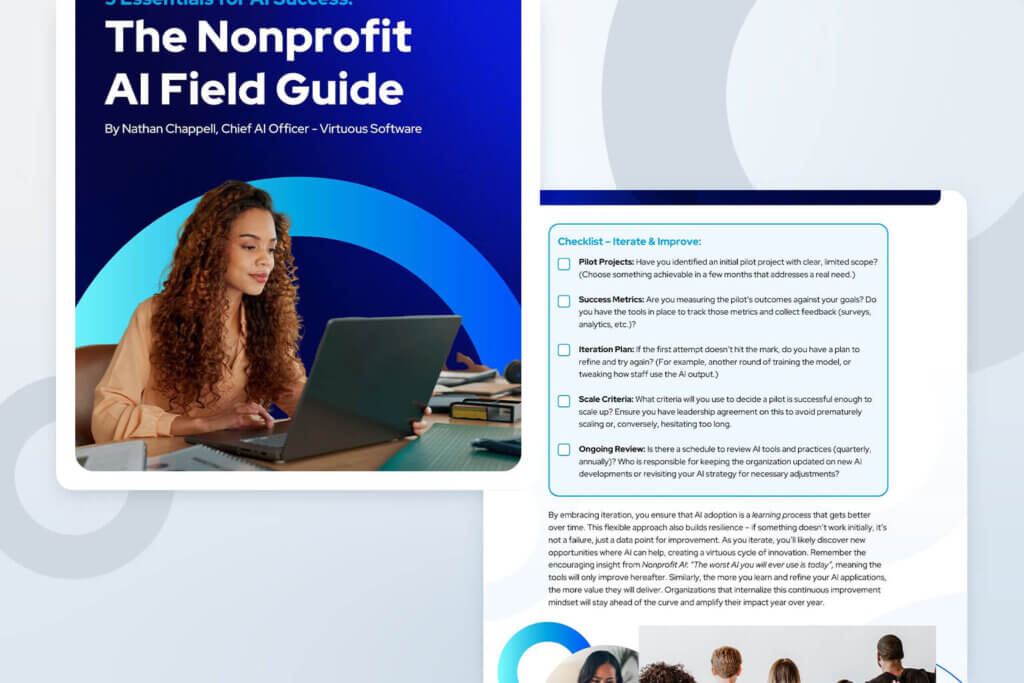
You can also download my e-book, 5 Essentials for AI Success: The Nonprofit AI Field Guide, where I explore a roadmap for nonprofit leaders looking to harness the power of AI sooner rather than later.