TL;DR:
- Consecutive giving programs reward donors for giving year after year, regardless of gift size, and they can have a significant impact on retention rates
- The University of South Florida’s Loyalty Herd program recognizes 20,000+ donors at milestone intervals with personalized, low-cost touchpoints
- You don’t need a huge budget or a large team to launch a consecutive giving program. Start small, leverage what you already have, and keep it genuine
- Avoid buyback programs (letting donors “buy back” missed years), because they undermine the behavioral loyalty you’re trying to build
- Focusing on giving behavior over gift size opens the door to planned gifts, upgrades, and deeper long-term relationships
You know those donors who show up every single year? Maybe they give $25. Maybe they give $500. The dollar amount changes, but the behavior stays the same. They keep coming back.
Most nonprofits don’t have a formal way to recognize that kind of loyalty. We tend to build recognition around gift size: major giving societies, lifetime giving levels, annual fund tiers. And those are important. But they leave a gap. What about the donor who’s given faithfully for 12 straight years at $50 each time? Where do they fit?
That’s the question a consecutive giving program answers. And it’s a question more fundraising teams are starting to ask.
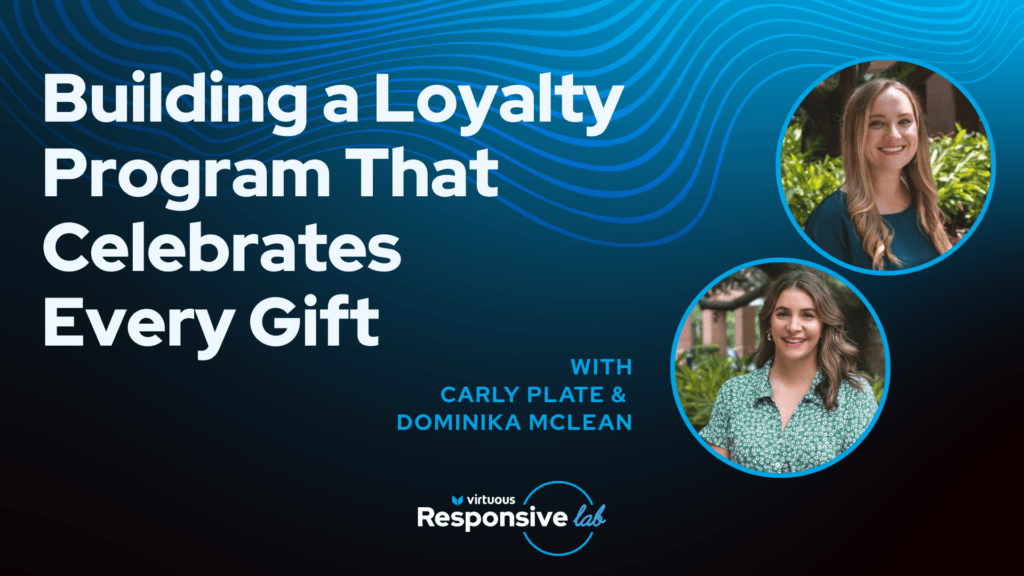
On a recent episode of The Responsive Lab, host Scott Holthaus sat down with Carly Plate, Director of Donor Relations and Stewardship at the University of South Florida, and Dominika McLean, a member of USF’s Donor Relations team, to talk about how they built and launched a consecutive giving program called the Loyalty Herd. The conversation covered practical lessons any nonprofit can apply, from structuring milestone touchpoints to keeping stewardship personal at scale. Here’s what we took away.
What Is a Consecutive Giving Program?
If you’re familiar with recurring giving, a consecutive giving program is a related but different concept. Recurring giving tracks donors who give on an automatic, repeating schedule (monthly, quarterly, etc.).
A consecutive giving program tracks donors who have given at least once per fiscal year, for multiple years in a row, regardless of when or how much they give.
At USF, the Loyalty Herd recognizes donors who have given for three or more consecutive fiscal years. There’s no minimum gift amount. A $10 gift counts. A $10,000 gift counts. What matters is that the donor didn’t miss a year.
Donors are then stewarded at milestone intervals: three years, five years, 10 years, 25 years, and 30 or more years. Each milestone comes with a specific touchpoint, and every donor in the program receives an annual impact email regardless of where they fall on the timeline.
The program currently includes over 20,000 donors, which tells you something about the depth of loyalty that already exists in most donor files. Those donors are there. They’re giving. The question is whether your organization is recognizing them for it.
Why Giving Behavior Matters More Than Gift Size
There’s a reason loyalty programs work in the for-profit world. Airlines, hotels, coffee shops. They all reward repeat behavior, not just spend. The psychology behind it is straightforward: when people feel recognized for showing up, they keep showing up.
The same principle applies to fundraising. And yet, many nonprofits still anchor their recognition programs around monetary thresholds.
USF’s approach flips that. By focusing on consecutive giving behavior rather than dollar amounts, the Loyalty Herd does a few important things:
- It includes donors at every level. A $25-a-year donor gets the same recognition milestones as a $5,000-a-year donor. This makes donor stewardship feel inclusive rather than hierarchical.
- It surfaces future major gift prospects. Donors who give faithfully for years often have deeper affinity than their gift size suggests. They may have the capacity for a larger gift, a planned gift, or an upgrade, but they need to see that the relationship is real first.
- It improves retention. USF reports a 69% donor retention rate, well above the industry average of 30-45%. The Loyalty Herd isn’t the only factor, but recognizing consistent behavior reinforces the habit of giving.
When you reward loyalty, you create a cycle. Donors feel seen. They come back. They deepen their connection. And over time, that connection grows into something much bigger than a single transaction.
5 Lessons for Launching Your Own Consecutive Giving Program
You don’t need to be a large university with a big advancement team to make this work. Here are the practical takeaways that any fundraising team can apply.
1. Start Small and Build From There
The most common reason nonprofits delay launching a program like this? Waiting for conditions to be perfect. The data isn’t clean enough, the team is too small, or there’s always another project that takes priority.
USF’s advice: start anyway. Your first version doesn’t have to be flawless. Pick a sustainable milestone structure you can commit to for at least two years. Use the tools you already have. If your team is good with Canva, use Canva. If you have a video tool like ThankView, create videos there.
The goal is to get something meaningful in front of your loyal donors, not to build a perfect system on day one.
2. Work With Your Data Team Early
Before you sketch out milestone touchpoints or design collateral, talk to your data management team. Can they pull consecutive giving data from your CRM? How will they define a fiscal year? What does the data pull look like after the year closes?
At USF, the data team provides a rough estimate of donor counts a few months before the fiscal year ends, which helps the donor relations team budget and order materials. Getting alignment early prevents the frustration of being ready to launch but unable to get the numbers you need.
If your CRM data isn’t perfect yet, that’s okay. Work with what you have and improve as you go.
3. Keep Touchpoints Low-Cost and High-Impact
You don’t need expensive gifts at every milestone. USF’s touchpoint structure is intentionally lean:
- 3 years: A welcome packet introducing the donor to the Loyalty Herd
- 5 years: A personalized email with a milestone video
- 10 years: A different personalized email with a unique video
- 25 years: A photo book designed in-house by a team member using InDesign
- 30+ years: An art poster from USF’s on-campus graphic studio, rolled up and mailed in a tube
Every one of these was created using existing resources. The photo book was designed by a student employee. The art posters were sourced from a campus partner at a reduced cost. The videos were made in collaboration with the communications and marketing team.
The key phrase here is low resource, low risk, high reward. You’re not mailing 20,000 packages every year. You’re only mailing to donors who cross into a new milestone, which keeps the volume manageable.
4. Don’t Offer a Buyback Program
This was one of the strongest pieces of advice USF received from peer institutions before launching: do not let donors “buy back” into the program after missing a year.
It’s tempting. A donor who gave for nine straight years misses year 10 and asks if they can make it up. But buybacks create two problems. First, they’re a data management headache to track in your donor management system. Second, and more importantly, they undermine the entire point of the program.
The whole idea is that loyalty means not missing a year. If donors can buy their way back in, the behavioral commitment loses its meaning. USF found that by keeping the rules simple and consistent, donors are actually more motivated to maintain their streak.
5. Plan for Unique Donor Segments
Not every donor in your file will see themselves the same way. USF ran into this with their public broadcasting station, WUSF. Those donors often see themselves as NPR supporters, not necessarily university supporters. Athletics donors can feel similarly separate.
Rather than excluding those groups, USF found ways to tailor the messaging. For public broadcasting donors, the stewardship language focuses on how their giving impacts the broader university community, even if it’s not directly tied to student success. Donor segmentation matters here. Think through which pockets of your donor base might need different messaging, and plan for it before you launch.
How a Consecutive Giving Program Fits Into Your Broader Strategy
A consecutive giving program isn’t a replacement for your other recognition efforts. It’s an addition. At USF, donors in the Loyalty Herd can also be part of lifetime giving societies, major gift donor stewardship portfolios, or first-time donor programs. Many of them are.
Think of it as the baseline layer of stewardship. The bare minimum every loyal donor receives, regardless of whether they have an assigned development officer or attend events. From there, donor engagement strategies can layer on additional touchpoints based on gift level, affinity, or prospect status.
This is what makes consecutive giving programs so powerful for donor retention. They ensure that no loyal donor falls through the cracks, even if your team is small. And they create a natural on-ramp for deeper engagement over time.
The Advice Worth Repeating
When asked for their best fundraising advice, both USF team members landed on the same theme: look at giving behaviors, not just giving amounts.
Your most loyal donors aren’t always your largest donors. But they’re often the ones with the deepest connection to your mission. They’re the ones most likely to increase their giving, make a planned gift, or become advocates for your organization.
And they deserve to know that you see them.
The other piece of advice? Don’t be afraid to innovate. You don’t need permission to try something new. If your leadership supports it, move quickly. If you have a small idea that could make a donor feel valued, share it. The nonprofits that are growing are the ones willing to drive innovation and experiment, even with limited resources.
Build Loyalty With the Right Tools
If you’re thinking about launching a consecutive giving program, the right technology makes a big difference. A platform that connects your giving data, automates personalized touchpoints, and gives your team a clear view of donor journeys can turn a manual process into a scalable one.
Virtuous CRM+ was built for exactly this kind of work: connecting donor behavior data with automated stewardship workflows so your team can recognize, engage, and retain donors without burning out.
Schedule a demo to see how Virtuous CRM+ can help you build deeper donor relationships at every giving level.
FAQs
What is a consecutive giving program?
A consecutive giving program recognizes donors who have given at least once per fiscal year for multiple years in a row, regardless of the gift amount.
How is consecutive giving different from recurring giving?
Recurring giving refers to automatic, repeating donations (like monthly gifts). Consecutive giving tracks whether a donor made at least one gift each fiscal year, regardless of frequency or automation.
What is a good starting point for consecutive giving milestones?
Many organizations start by recognizing donors at three consecutive years, then add milestones at five, 10, 25, and 30+ years.
Do you need a large budget to run a consecutive giving program?
No. USF runs their Loyalty Herd with a small team of four and uses low-cost, in-house resources like Canva, student-designed materials, and campus partnerships for milestone gifts.
Should you allow donors to buy back into a consecutive giving program?
Most practitioners advise against buybacks. They create data management challenges and weaken the behavioral commitment that makes the program meaningful.
How does a consecutive giving program improve donor retention?
By recognizing loyal giving behavior, you reinforce the habit of giving and deepen the donor’s emotional connection to your organization, which leads to higher retention over time.