TL;DR
- 92% of nonprofits are using AI, but only 7% are using it strategically enough to see real impact on their mission.
- The biggest barrier to nonprofit AI adoption isn’t access to tools but rather the absence of strategy, governance, and documented workflows.
- 47% of organizations have no AI policy at all, leaving teams without a shared foundation for responsible, effective use.
- Accelerating poor fundraising practices with AI won’t just fail to help; it could accelerate donor disengagement and staff burnout.
- The nonprofits seeing real results are slowing down, identifying high-yield problems, and building a culture of curiosity and experimentation.
Nonprofit AI adoption is everywhere. But is it actually working?
If you’re a fundraising leader wondering whether your organization is keeping pace with AI, you’re not alone. There’s a widespread fear of falling behind…a sense that everyone else has figured something out that you haven’t. But the data tells a different story. Most nonprofits are experimenting with AI, yet almost none of them are using it in a way that’s meaningfully changing outcomes.
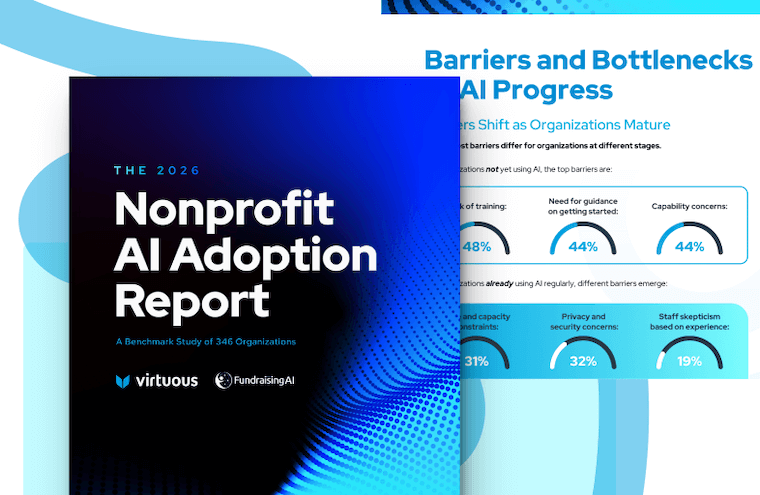
This post is based on a conversation with Nathan Chappell, Chief AI Officer at Virtuous, on Episode 75 of The Responsive Lab. Nathan joined hosts Scott Holthaus and Carly Berna to unpack the findings of The 2026 Nonprofit AI Adoption Report, a benchmark study of 346 nonprofits that revealed a striking gap between AI usage and AI impact. You can watch or listen to the full episode below.
Watch the full episode:
Prefer audio? Listen on your platform of choice:
→ You can also download the full 2026 Nonprofit AI Adoption Report HERE.
What Nathan surfaces goes beyond the numbers. It’s both a wake-up call and a practical roadmap for any nonprofit trying to figure out where to go next with AI.
The Nonprofit AI Adoption Paradox: Widespread Use, Minimal Impact
92% of nonprofits are now using AI, up from single digits just two years ago. But only 7% describe their use as strategic, meaning they’re seeing real ROI and measurable mission impact.
Nathan calls this the AI adoption paradox. The core distinction he draws is this: the organizations seeing results aren’t thinking about AI as a set of tools. They’re thinking about it as an evolution in how work gets done.
The rest? They’re largely treating AI as a collection of subscriptions and one-off prompts. In fact, the report found that 65% of organizations describe their AI use as reactive and individual…things like personal ChatGPT accounts and ad hoc experimentation without shared goals or measurement.
This means that for the vast majority of nonprofits, AI adoption hasn’t changed the way they approach their work at all. It’s just made them busier.
Why “Doing More” with AI Can Actually Make Things Worse
One of Nathan’s most important observations is what happens when nonprofits use AI to simply do more of the same work.
As he puts it: “If we have a tool that can accelerate the amount of work that I’m expected to produce, at what point does that lead to me being totally burned out?”
This is a real and growing concern. If AI increases output, and that becomes the new baseline expectation, the result isn’t transformation. It’s faster burnout layered on top of an already strained workforce. Nathan describes it as “throwing gasoline on the retention crisis” that already exists in the nonprofit sector.
But the risks go beyond staff wellbeing. If the fundraising practices being accelerated are already too transactional, AI doesn’t fix them; it amplifies them.
As Nathan puts it directly: “If you put something digital on top of something that’s broken, you have a digital broken thing.”
In his book The Generosity Crisis, Nathan and his co-authors mapped out the long-term consequences of this trajectory. Charitable participation in the U.S. has already dropped to about 49% of Americans, down from much higher historical levels. If nonprofits use AI to double down on transactional fundraising, that decline could accelerate dramatically, compressing what might have been a 49-year erosion into a matter of years.
Why AI Governance Is the Starting Point for Nonprofit AI Adoption
One of the report’s most revealing findings is that 47% of nonprofits have no AI policy at all. When Nathan asks this question at conferences, the number is often even lower…closer to 5%.
His view is emphatic: creating an AI governance policy is the single most important step a nonprofit can take to move from reactive AI usage to strategic impact.
Here’s why. Without a policy, there’s no shared source of truth that aligns the use of AI tools with an organization’s values. Individual team members are left guessing. Some experiment quietly. Others resist entirely. And leadership has no framework for evaluating what’s working.
Nathan also stresses that an AI policy can’t be a static document that sits on a shelf. Unlike a data policy that rarely changes, an AI governance policy is a living document that should be revisited every 6 months. It should address evolving questions like:
- What is our position on autonomous fundraising?
- How do we protect donor data when using AI tools?
- What guardrails exist for how AI-generated content is reviewed and approved?
For nonprofits that operate in the currency of trust…which is every nonprofit…this kind of governance isn’t optional. It’s foundational.
In the 2026 Nonprofit AI Adoption Report, we’ve included a sample AI governance policy prompt. Customize to your org. Then, enter into your AI model of choice to generate an AI policy for your org.
We recommend starting here, as this is far easier than starting from scratch.
→ Download the report now to access this Governance Policy Prompt.
How to Break Through the AI Efficiency Plateau
A pattern shows up repeatedly among nonprofits that have been using AI for a year or more: faster execution of the same work, but no fundamental change in what the team is capable of. Same staff size. Same processes. Just busier.
Nathan’s response to this pattern is direct: that’s normal. Most nonprofits have been in “wild west” mode with AI, buying tools without strategy and measuring success by how much money they spend rather than what problems they solve.
The organizations that actually break through slow down before they speed up, start with high-yield, low-risk problems, document what works, and build cross-functional teams empowered to experiment.
The through-line Nathan keeps returning to is deceptively simple: treat AI as an evolution in how work gets done, not a faster way to do the same work.
Why 2026 Is the Year That Defines Nonprofit AI Adoption for Years to Come
Nathan draws a compelling parallel to the early days of Facebook advertising in the nonprofit space. Organizations that were slow to adopt digital fundraising strategies found themselves years behind, struggling to catch up with peers who had built digital donor pipelines early.
AI presents a similar inflection point…but with even higher stakes.
AI is an exponential technology. Unlike social media platforms that evolve incrementally, AI improves at a compounding rate, and it doesn’t need humans to drive that improvement. The worst AI you’ll ever use is today’s AI. Tomorrow’s will be better. And the gap between organizations that are building AI fluency now and those that are waiting will widen faster than most leaders expect.
Nathan references a 2018 Harvard Business Review article with a title that still rings true: “…Companies That Wait to Adopt AI May Never Catch Up.” [1]
Nonprofits building AI capabilities today are developing culture, habits, and institutional knowledge that will make them exponentially more effective in the years ahead. Those who wait risk not just falling behind, but forming bad habits that become harder to break in 2027 and 2028.
The Tools That Turn AI Strategy into Fundraising Impact
Nathan’s framework for moving from the broad 92% into the strategic 7% centers on two sides of the same coin: predictive AI and generative AI.
Predictive AI helps fundraisers understand what to focus on. Nathan has spent just under a decade pioneering machine learning in fundraising, and he points to Virtuous Insights as an example of this in action. By combining first-party CRM data with third-party wealth, demographic, and engagement data, Insights gives fundraisers a high degree of confidence about which donors are most likely to respond, make a gift, or deepen their connection.
Generative AI helps fundraisers act on those insights at scale. Virtuous Momentum bridges the gap between knowing who to engage and actually doing it. Momentum uses AI to help gift officers prioritize their daily work, draft personalized outreach in their own voice, and manage donor plans that adapt in real time.
Together, these capabilities unlock what Nathan describes as a new era of precision philanthropy, where every donor interaction is informed, personal, and strategic rather than the exhausting “spaghetti at the wall” approach that burns out fundraisers and alienates donors.
He also notes that generative AI tools serve as a kind of thought partner for fundraisers, who often work in isolation. Being able to role-play donor conversations, brainstorm approaches, and test messaging in a low-stakes environment is a meaningful shift for people in what Nathan calls “a very lonely job.”
An Infinite Mindset for a Moment of Infinite Possibility
Nathan’s most important advice for fundraisers today goes beyond tactics:
Shift from a scarcity mindset to an infinite mindset.
In a world where AI knows something about everything and can seemingly do anything, the fundraisers who thrive will be the ones who believe that anything is possible…and then work to find what isn’t, rather than the other way around. That kind of mindset, combined with tools that can actually deliver on it, is what makes this moment in nonprofit fundraising so full of potential.
What to Do Next
If you’re ready to move from reactive AI use to something more strategic, here are a few places to start:
- Read The 2026 Nonprofit AI Adoption Report. It includes not just the data, but practical frameworks, prompts for building your governance policy, and a clear roadmap for getting started.
- Explore Virtuous Momentum. See what it looks like when predictive and generative AI work together for fundraisers.
- Explore Virtuous Insights. Unlock donor signals, giving predictions, and enriched profiles that help your team focus on the right people at the right time.
Further Reading: Nathan Chappell on AI in Fundraising
If this post sparked your thinking, check out some of Nathan’s other posts:
- Top 5 Questions Nonprofits Ask About How to Implement AI — Nathan answers the questions he hears most often from development directors and nonprofit leaders on the ground.
- When Nonprofits Embrace AI: Extraordinary People & Tools — A rallying piece for mission-driven leaders: why the people doing this work are anything but ordinary, and why the tools now match their potential.
- Overcoming the Competition for Connection — Nathan’s argument that nonprofits aren’t just competing for dollars anymore; they’re competing for connection…and what to do about it.
Frequently Asked Questions
What is the 2026 Nonprofit AI Adoption Report?
A benchmark study by Virtuous surveying 346 nonprofits about their real-world AI usage in fundraising, focused on what’s actually happening day-to-day, not aspirational goals.
What is the “AI adoption paradox” in nonprofits?
It’s the gap between 92% of nonprofits using AI and only 7% reporting real mission impact…because most organizations are using AI to go faster, not to work differently.
Why are so few nonprofits seeing real results from AI?
The root cause is structural: 47% have no AI governance policy and 81% use AI ad hoc without documenting what works, so learning never compounds across the team.
What should a nonprofit AI governance policy include?
At minimum: your position on autonomous fundraising, how donor data is protected in third-party AI tools, and an approval process for AI-generated content, revisited every six months as the technology evolves.
What’s the difference between predictive AI and generative AI in fundraising?
Predictive AI tells you which donors to focus on; generative AI helps you engage them at scale without losing the personal touch.
How does Virtuous Momentum help gift officers?
It gives gift officers a prioritized daily plan, drafts personalized outreach in their own voice, and manages donor portfolios in real time — turning what used to take hours into minutes.
How is AI affecting donor retention and the generosity crisis?
If AI accelerates transactional fundraising rather than deepening relationships, it could compress a decades-long decline in charitable participation into just a few years, a risk Nathan explores in depth in The Generosity Crisis.
What’s the first step for a nonprofit that wants to use AI more strategically?
Write a one-page AI governance policy before adding more tools, then pick one high-yield, low-risk problem to solve well and document what works.
Sources:
[1] https://hbr.org/2018/12/why-companies-that-wait-to-adopt-ai-may-never-catch-up