| TL;DR → Choosing the best CRM for nonprofits in 2026 should match how your team fundraises today and how you plan to grow tomorrow. → Modern nonprofit CRMs go far beyond donor records, bringing together giving, engagement, communication, automation, and insights in one place. → The right CRM should reduce manual work, improve donor visibility, and support relationship-based fundraising at scale. |
There is no universal best CRM for nonprofits.
But there is a best CRM for your nonprofit based on how you fundraise, how your team works, and where your organization is headed next. In 2026, nonprofit CRMs have moved way beyond just places to store donor records; they’re the systems that shape how relationships are built, stewarded, and scaled over time. And now with the power of AI, you can expect even more from your nonprofit CRM.
So, as a fundraiser, if you’re facing:
→ Multiple disconnected systems
→ Difficulty pulling or analyzing data
→ Manual workarounds and inefficiencies
→ Lack of intuitive interfaces or support
…it might be time to embrace the AI era and update your tech.
At Virtuous, we understand that choosing the best CRM for your nonprofit can mean the difference between meeting your fundraising goals or falling behind for the year. As the only AI-powered Responsive Fundraising Platform, we equip nonprofits to connect personally with every donor, automate time-consuming workflows, and turn data into action…all via our suite of enterprise-grade fundraising products.
And to quote one of our customers referencing her old nonprofit CRM: “It felt like they were letting it die. Like it was just going to drift slowly and you had to jump ship at some point or sink with it.” — Viviana Briseno, Development Operations Manager, Rainforest Foundation US
If you feel like your old nonprofit CRM is sinking slowly (or quickly), and you’re not about to sink with it, this guide will help you understand what to look for in a new CRM, how to evaluate options, and which platforms are most commonly considered the best CRM software for nonprofits today.
What Is a Nonprofit CRM?
First, let’s start with some basic definitions.
A nonprofit CRM is a system designed to help organizations manage relationships with donors, volunteers, members, and other supporters. At its most basic level, a CRM stores contact information and donation history. But the best CRM for nonprofits goes far beyond that.
Modern nonprofit CRMs connect giving data, engagement history, communication, events, volunteer activity, and context into a single view. This allows fundraising teams to see the full story of a supporter instead of just a transaction log. And when this happens, you can view your donor as a whole person and not just a data point.
As fundraising becomes more relationship-driven, the best CRM for nonprofits should support donor retention, major gifts, automation, reporting, and personalized engagement all in one place. For organizations still juggling spreadsheets and disconnected tools, a CRM becomes the foundation for sustainable growth.
Questions to Ask Before Choosing a Nonprofit CRM
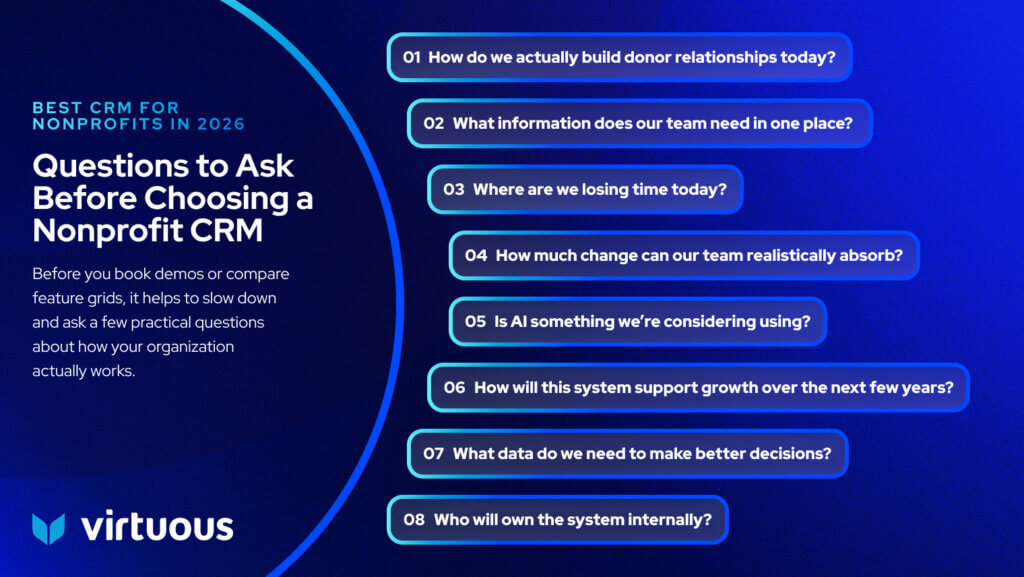
Before you book demos or compare feature grids, it helps to slow down and ask a few practical questions about how your organization actually works.
1) How do we actually build donor relationships today?
Think about how your team engages donors day to day. Are gift officers managing portfolios and follow-ups manually? Are thank-yous personalized or templated? Do you know when donors disengage, or only after they stop giving?
A strong CRM should reflect how relationships already work, while helping you improve consistency and visibility without adding friction.
2) What information does our team need in one place?
Ask yourself what your fundraisers need to see before making a call, sending an email, or preparing for a meeting. Giving history alone is rarely enough.
The best CRM for nonprofits brings together communication history, engagement, events, volunteer activity, and relevant context so fundraisers don’t have to hunt for answers across systems.
3) Where are we losing time today?
Most CRM frustrations show up as small inefficiencies that add up: manual data entry, duplicate follow-ups, missed reminders, or disconnected reporting.
Before choosing a platform, identify where your team is spending time on work that feels repetitive or reactive. A CRM should reduce that load through smart automation, not create new busywork.
4) How much change can our team realistically absorb?
Some platforms offer deep flexibility but require significant configuration. Others prioritize usability and fundraising best practices out of the box. Be honest about your internal capacity for training, setup, and ongoing administration.
5) Is AI something we’re considering using?
Using AI in your fundraising can save major time while still allowing you to keep your messaging personal. Evaluate team openness to AI, and consider whether or not you have an AI policy before considering AI tools.
6) How will this system support growth over the next few years?
It’s easy to choose a CRM that fits your organization today. It’s harder, and more important, to choose one that won’t limit you later.
Consider how your fundraising strategy might evolve. Will you add major gifts? Expand volunteer programs? Invest more in data and analytics? The best CRM for nonprofits should scale alongside your ambitions without forcing a full rebuild.
7) What data do we need to make better decisions?
Ask whether your future CRM will help you understand donor behavior, spot opportunities earlier, and make informed decisions, or whether you’ll still rely on exports and spreadsheets to fill in the gaps.
8) Who will own the system internally?
Even the best CRM needs an internal champion. Clarify who will manage data health, workflows, and reporting, and how much support they’ll need from the vendor.
Strong onboarding, documentation, and customer support often matter just as much as features.
How to Choose the Best CRM for Nonprofits
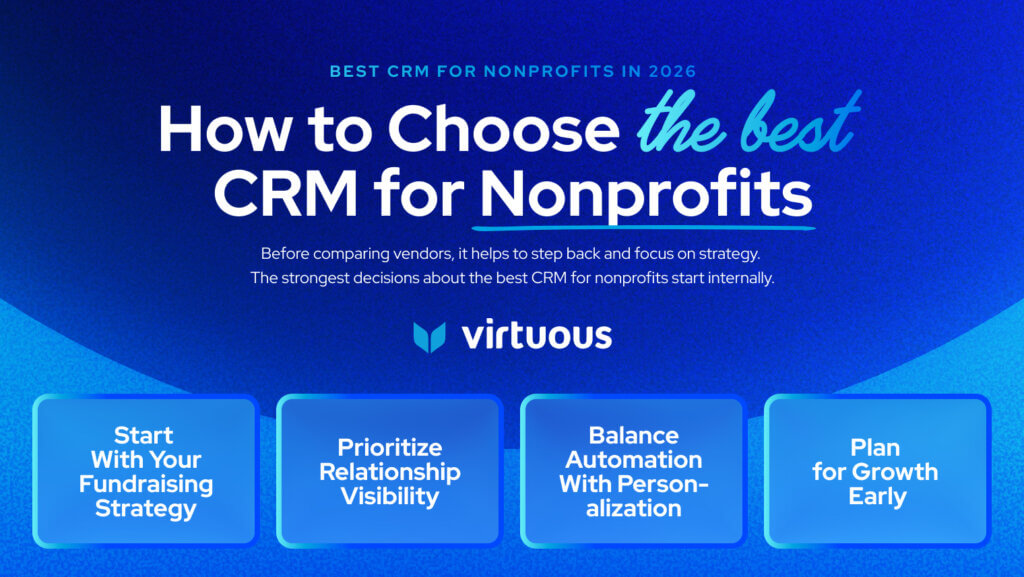
Before comparing vendors, it helps to step back and focus on strategy. The strongest decisions about the best CRM for nonprofits start internally.
1. Start With Your Fundraising Strategy
Every nonprofit raises money differently. Some prioritize donor retention. Others focus on major gifts, events, digital campaigns, or volunteer-driven fundraising. The best CRM software for nonprofits should support how you already raise money while helping you grow into what comes next.
A system built for simple donation tracking may struggle to support a growing major gifts program. Likewise, enterprise platforms may feel overwhelming for organizations still building their fundraising foundation.
2. Prioritize Relationship Visibility
The strongest CRMs are donor-centered. The best CRM for nonprofits makes it easy for your team to understand who a donor is, how they engage, and where they are in the relationship.
Look for platforms that surface giving history, communication, engagement, relationships, and relevant context in one place. When fundraisers can quickly see the full picture, conversations become more meaningful and timely.
Virtuous CRM+ is built around this idea, offering a 360-degree donor view that supports responsive, relationship-based fundraising.
3. Balance Automation With Personalization
Automation should save time without making your fundraising feel robotic. The best CRM for nonprofit organizations allows teams to automate acknowledgments, reminders, and workflows while still supporting personal outreach that feels human.
As fundraising grows more complex, automation becomes less about efficiency alone and more about enabling better relationships at scale.
4. Plan for Growth Early
Many nonprofits outgrow their first CRM faster than expected. What works as the best CRM for small nonprofits today may limit growth tomorrow.
If you plan to scale fundraising, add staff, expand programs, or deepen donor engagement, choose a platform that can grow with you.
Our Nonprofit CRM Checklist is a helpful tool here, walking through top features to look for in a CRM and how to determine which ones meet your needs.
Core Features of the Best CRM for Nonprofits
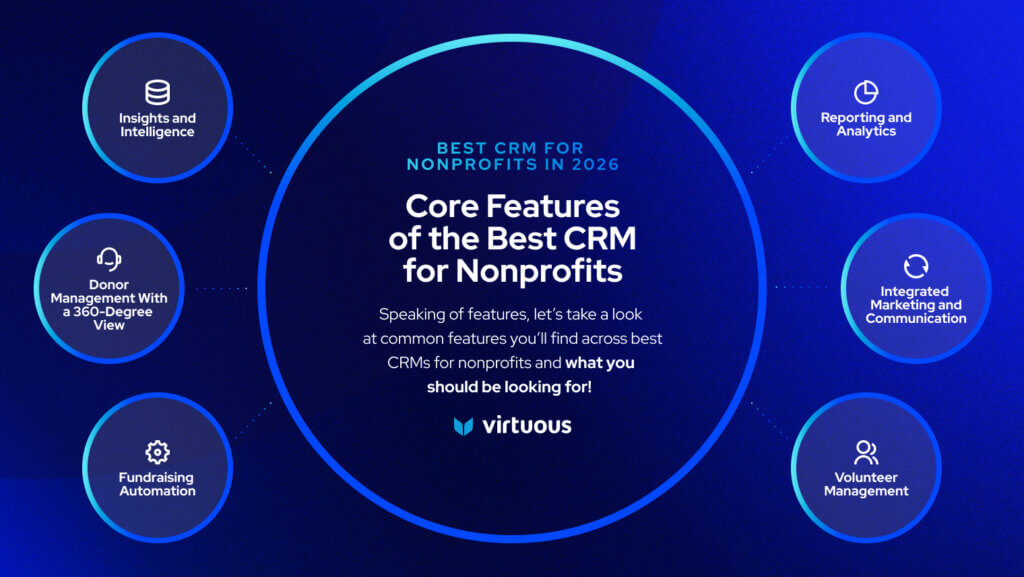
Speaking of features, let’s take a look at common features you’ll find across best CRMs for nonprofits and what you should be looking for!
Donor Management With a 360-Degree View
Strong CRMs will take giving history to the next level and show you the full donor. This includes giving, engagement, communication, household connections, events, and context that helps fundraisers connect meaningfully.
Virtuous CRM+ is designed around this approach, giving teams a complete view of supporters across fundraising and engagement.
Fundraising Automation
Let’s face it: adding personal touches to your communication sounds great in theory. But the reality of manually adding this to your day-to-day workload? Low.
On the flipside, many nonprofits feel skeptical about automation for fear that it will remove them from the communication.
The best CRM software for nonprofits automates routine tasks while preserving personalization.
Virtuous CRM+ includes built-in automation for workflows, acknowledgments, and follow-ups.
Or if you want an AI-powered fundraising assistant helping you in your email inbox, Virtuous Momentum is a great option.
Integrated Marketing and Communication
Email, SMS, and direct mail should not live in separate systems. The best CRM for nonprofits connects communication directly to donor behavior so outreach is timely and relevant.
Reporting and Analytics
Most CRMs include reporting, but depth matters. Virtuous CRM+ includes core dashboards and reporting to support everyday fundraising visibility. Virtuous Analytics extends those capabilities for enterprise organizations that need deeper insight, advanced dashboards, and role-based access across teams.
Insights and Intelligence
Many nonprofits now rely on wealth screening and donor intelligence to better understand a supporter’s capacity, interests, and likelihood to give. When this kind of data is connected directly to your CRM, teams can identify high-potential donors sooner, tailor outreach more effectively, and focus time where it will have the greatest impact. Instead of reacting after donors disengage or opportunities are missed, insight-driven fundraising helps organizations act with confidence and intention.
Volunteer Management
Volunteers play a huge role in most nonprofits, and they shouldn’t be treated like a separate audience. When volunteer data lives outside your CRM, it’s easy for those relationships to get siloed and overlooked. The best CRM for nonprofits makes it easy to manage volunteers, offer a smooth sign-up and engagement experience, and understand how volunteering connects to giving and long-term support.
19 Best CRMs for Nonprofits in 2026
Now that you know what to look for, it’s time to dive into the best CRM for nonprofits in 2026. Best CRM for Nonprofits of All Sizes and Scalability
We’re a bit partial to #1, but we also know that not every CRM is the best fit for every nonprofit team. So, we hope our list below can help you on your journey of finding the best CRM for you.
1. Virtuous CRM+
We already acknowledged our bias, but what can we say? We truly believe in our fundraising products. Virtuous CRM+ is a modern, connected platform built specifically for nonprofit fundraising. It combines donor management, automation, marketing, events, and reporting in one system designed to support responsive fundraising.
Pros
Virtuous CRM+ is first and foremost centered on helping fundraisers built stronger relationships with their donors. It offers strong donor visibility, automation, and integrated tools that scale with growing teams. Organizations can start with core CRM+ capabilities and then expand by adding on Virtuous Insights as a wealth screening tool, Virtuous Volunteer for volunteer relationship management, and Virtuous Analytics for enterprise-grade data and reporting.
Plus, nonprofits who don’t use CRM+ can still benefit from other relationship-building products:
→ Virtuous Raise: Our online giving platform.
→Virtuous Momentum: Our AI fundraising assistant that helps gift officers structure daily outreach and sends personalized emails at scale.
Want to see Virtuous CRM+ in action? Book a Virtuous CRM+ demo now!
Cons
Virtuous is intentionally positioned around relationship-based fundraising. Teams coming from transactional systems may need to adjust workflows to align with donor-centered best practices.
2. Salesforce Nonprofit Cloud
Pros
Enterprise-grade CRM with nonprofit-specific packaging
Large ecosystem of integrations and partners through Salesforce AppExchange
Cons
Implementation and ongoing administration often require dedicated internal resources or outside consultants
High cost for additional platforms needed to get a functioning system
See how Virtuous CRM+ stacks up against Salesforce HERE.
3. Microsoft Dynamics 365 and Power Platform
Pros
Integrates well with Microsoft tools like Outlook, Excel, and Teams
Supports enterprise-scale customization across departments
Cons
Not delivered as a single out-of-the-box nonprofit CRM
Implementation commonly requires partner or IT support
4. Blackbaud Raiser’s Edge NXT
Pros
A well-known name in the nonprofit technology sector.
Cons
Users frequently report a learning curve and system complexity, especially for newer users
See how Virtuous CRM+ stacks up against Blackbaud Raiser’s Edge NXT HERE.
5. Bonterra
Pros
Positioned as a broader ecosystem of nonprofit engagement and fundraising tools
Appeals to organizations seeking multiple solutions beyond a core CRM
Cons
Modular structure requires upfront decisions about which components to adopt
Onboarding and configuration can be more involved
6. CharityEngine
Pros
Offers advanced customization and workflow capabilities
Often evaluated by fast-growing and enterprise nonprofits
Cons
Setup and onboarding can require more time and technical effort than lighter platforms
Best CRM for Small to Mid-Sized Nonprofits
These CRMs are commonly shortlisted by organizations that need nonprofit-specific tools without full enterprise complexity.
7. Bloomerang
Pros
Nonprofit-first CRM focused on donor retention and engagement
Provides a clear, centralized view of donor activity
Cons
Growing organizations should confirm scalability as fundraising complexity increases
See how Virtuous CRM+ stacks up against Bloomerang HERE.
8. Keela
Pros
Combines donor management, fundraising, and communication tools
Positioned as an all-in-one platform for nonprofits
Cons
Organizations should confirm integration depth as needs evolve
9. DonorPerfect
Pros
Long-standing nonprofit CRM with configurable fundraising tools
Often evaluated by organizations planning gradual growth
Cons
Feature depth and workflows vary by package and configuration
See how Virtuous CRM+ stacks up against DonorPerfect HERE.
10. Neon CRM
Pros
Nonprofit-specific CRM within the Neon One ecosystem
Often included on shortlists for donor management and fundraising operations
Cons
Feature depth and flexibility vary depending on selected package
11. GoFundMe Pro
Pros
Strong focus on digital campaigns and online fundraising execution
Designed to help teams launch fundraising campaigns efficiently
Cons
Organizations seeking deeper donor relationship management may need additional systems
Learn more about how Virtuous integrates with GoFundMe Pro HERE.
12. HubSpot CRM
Pros
Strong marketing automation and pipeline tools
Offers a free CRM option
Cons
Not designed specifically for nonprofit fundraising workflows
Learn more about how Virtuous integrates with HubSpot HERE.
Best CRM for Small / Growing Nonprofits
These tools are most often used by early-stage or resource-constrained nonprofits prioritizing ease of use and fast setup.
13. DonorDock
Pros
Centralizes donor management and outreach in one workspace
Designed specifically for small nonprofits
Cons
Integration options should be evaluated early for growing teams
14. Little Green Light
Pros
Emphasizes simplicity and accessibility for smaller organizations
Often chosen for ease of use
Cons
Advanced workflows and reporting may be limited as organizations scale
15. Donorbox
Pros
Strong digital fundraising and donation form capabilities
Popular for online giving
Cons
CRM functionality may feel secondary for complex fundraising programs
16. Funraise
Pros
Supports modern, digital-first fundraising experiences
Well-suited for campaign-based fundraising teams
Cons
Long-term CRM depth should be evaluated for relationship-driven fundraising
17. Givebutter
Pros
Lower barrier to entry for early-stage nonprofits
Commonly used for simple fundraising and events
Cons
Growing nonprofits may outgrow its CRM functionality
18. Zoho CRM and Zoho for Nonprofits
Pros
Flexible CRM ecosystem with nonprofit discounts
Supports a wide range of business-style workflows
Cons
Nonprofits must adapt the platform to fit donor management needs
19. EngageBay
Pros
Includes basic contact management and email tools
Offers a free entry-level plan
Cons
Not purpose-built for nonprofit fundraising
Choosing the Right Nonprofit CRM for You
Choosing the best CRM for nonprofits is not about finding the longest feature list. It is about choosing a system that helps your team build better relationships, save time, and grow generosity.
If you are exploring platforms and want a donor-centered CRM designed to scale, Virtuous CRM+ is worth a closer look.
Book a CRM+ demo and see how responsive fundraising works in practice.
Frequently Asked Questions
Is there a free CRM for nonprofits?
Yes. Tools like Givebutter, HubSpot CRM, Zoho CRM, and EngageBay offer free options. The best free CRM for nonprofits can be a good starting point, but growing teams often outgrow free tools quickly.
Does a nonprofit need a CRM?
If donor relationships matter, a CRM is essential. The best CRM for nonprofits replaces spreadsheets with clarity and consistency.
What is the simplest CRM to use?
Simplicity depends on team needs. Smaller nonprofits often gravitate toward nonprofit-first platforms with intuitive workflows.
What is the number one CRM platform?
Though we’re partial to Virtuous CRM+, there is no single number one system. The best CRM for nonprofits is the one that fits your fundraising strategy, team capacity, and growth goals