In the nonprofit sector, every resource counts, and efficiency is key to maximizing impact. One of the most crucial tools for managing relationships, donations, and communications is your Customer Relationship Management (CRM) system. If your nonprofit hasn’t evaluated its CRM recently, now might be the perfect time to consider a change. Here’s why it’s so important to change CRMs now and how it can significantly benefit your organization and help you achieve your mission effectively.
1. Technological Advancements
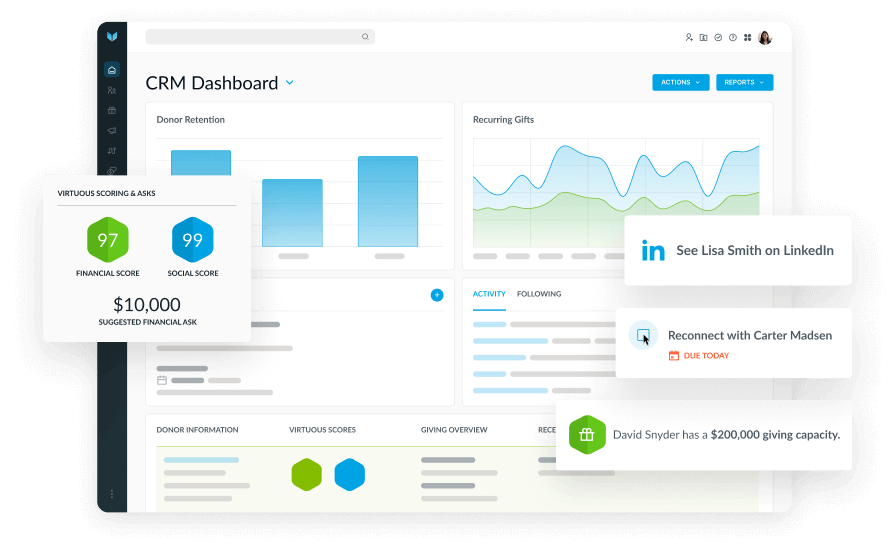
CRM technology has advanced considerably, offering powerful features that can transform nonprofits’ operations. Modern CRMs, like Virtuous, provide advanced data analytics, automation, and seamless integration with other tools. These capabilities can help nonprofits manage donor relationships more effectively, optimize fundraising campaigns, and improve overall decision-making. Nonprofits save valuable time when marketing tools like email are seamlessly integrated into their CRM. Beyond the time savings, nonprofits can make communications more personal with better segmentation, leading to a more holistic view of donors.
Learn why systems must work together and how a lack of data integration can hinder nonprofits.
Example:
A nonprofit struggling to analyze donor data with an outdated CRM could switch to a modern system that uses AI. This can help identify donation patterns and suggest personalized engagement strategies, leading to increased donor retention and contributions.
2. Overcoming Negative Trends in the Nonprofit Sector
It’s a statistic no nonprofit wants to hear: giving is down, and donor retention is lagging. According to the Giving USA 2024 report, when adjusted for inflation, total giving declined by 2.1% in 2023. While giving did reach a high in current dollars, it could not outpace inflation, and because of that, nonprofits need more donors.
Individual donors are cutting back or discontinuing their giving, so focusing on retaining donors is important, as retaining current donors is more cost-effective.
To overcome these challenges, nonprofit organizations need the best tools so they can continue to drive their mission forward. A CRM is vital to the nonprofit toolkit, allowing fundraisers, marketers, and more to connect with donors and increase donations.
Automation unlocks massive time savings, while scaling personal connections. Using these tools can give you more time to focus on meaningful strategy and overcome the downward trend in giving.
Example:
A nonprofit noticed an uptick in lapsed donors, so it ran a multichannel fundraising campaign to reactivate those donors and strengthen its retention rate. Thanks to Virtuous, which could connect to other tools, the nonprofit was able to build custom automation workflows between its systems, ensuring smooth data transfers and up-to-date contact records. This allowed the nonprofit to launch a campaign that successfully re-engaged lapsed donors and had a 684% direct response return on investment.
NONPROFIT CRM
Is Your CRM Letting You Down?
Don’t let a bad CRM experience get in the way of your mission. See how the responsive fundraising tools in Virtuous can increase generosity.

3. Enhanced Donor Management
Nonprofits rely heavily on building and maintaining strong relationships with donors. A modern CRM can provide a 360-degree view of donor interactions, preferences, and giving history, allowing for more personalized and meaningful engagement. This enhanced donor management can lead to stronger relationships and increased donor loyalty.
Example:
A charity using an old CRM struggled to keep track of donor communications. By switching to a new system, they gained the ability to automate personalized thank-you messages and track donor engagement, resulting in higher donor satisfaction and repeat donations.
4. Scalability for Growth
As your nonprofit grows, so do your needs. An outdated CRM may not be able to handle an expanding database or increased user demands. Virtuous built to scale, ensuring it can support your growth without compromising performance or usability.
Example:
A small nonprofit experiencing rapid growth found its old CRM couldn’t keep up with the increasing number of volunteers and donors. Transitioning to a scalable CRM allowed them to manage their expanding database and support their growing mission efficiently.
See volunteer management in action with March to the Polls.
5. Enhanced Security
Protecting sensitive donor and volunteer information is crucial for nonprofits. Older CRMs may not offer the robust security features needed to safeguard this data. Modern CRMs provide advanced security measures, including encryption and multi-factor authentication, ensuring your data is protected from breaches.
Example:
After experiencing a data breach due to outdated security in their old CRM, a nonprofit switched to a new system with state-of-the-art security features. This change not only protected their data but also restored the trust of their donors and stakeholders.
6. Improved Reporting and Insights
Accurate reporting and actionable insights are vital for nonprofits to demonstrate impact and make informed decisions. Modern CRMs offer sophisticated reporting tools that provide real-time data and analytics, helping you measure success and identify areas for improvement.
Example:
A nonprofit using a basic CRM struggled to generate detailed reports for their board meetings. By moving to Virtuous, they could easily create comprehensive reports with visual analytics, showcasing their impact and guiding strategic planning.
7. Cost Efficiency
While the upfront cost of switching CRMs can be a concern, the long-term benefits often outweigh the investment. Virtuous can reduce operational costs through automation, improved efficiency, and better resource allocation, ultimately saving your organization money.
Example:
A nonprofit hesitated to switch CRMs due to budget constraints. However, after calculating the savings from automating administrative tasks and improving donor management, they realized the new CRM would be cost-effective in the long run.
Conclusion
There’s no time to waste. Changing your CRM now can unlock a wealth of opportunities for your nonprofit organization. From leveraging the latest technological advancements and enhancing donor management to improving scalability, security, and reporting, the benefits are clear. While the transition might require an upfront investment in both time and resources, the long-term gains in efficiency, productivity, and donor satisfaction make it a strategic move worth considering.
Is your nonprofit’s current CRM holding you back? Then you need something better. Explore Virtuous‘s modern CRM solutions and empower your mission with the tools it needs to succeed.