TL;DR:
- Wealth screening software helps nonprofits identify donors with the capacity and inclination to give more
- The best wealth screening software for fundraising in 2026 combines wealth data with behavioral signals and integrates directly with your CRM
- Key features to evaluate include data accuracy, predictive scoring, automation capabilities, and ease of use
- Wealth screening differs from prospect research in scope and depth
- Choosing the right donor wealth screening software depends on your organization’s size, goals, and existing tech tools
Every donor in your file tells a story. But some of those stories have chapters you haven’t read yet.
That $50-a-month donor your team already loves? They might also own multiple properties, serve on two nonprofit boards, and have the capacity to fund an entire program.
Not because their current gift isn’t meaningful, but because there’s potential your team hasn’t had the tools to uncover.
Wealth screening software changes that. These tools scan your donor file against external data sources (public records, real estate holdings, stock ownership, philanthropic history, and more) to reveal giving capacity across your entire database.
So, the goal isn’t to replace the relationships you’ve built. It’s to deepen them with better information.
Of course, not all screening tools work the same way, and choosing the wrong one can mean paying for data your team never acts on. This guide breaks down what wealth screening software actually does, which features matter most, and how to find the right fit for your organization.
At Virtuous, we built our wealth screening software tool to pair perfectly with Virtuous CRM+ because we believe data should live where your team already works. We’ll walk you through the top tools on the market (including ours), what to look for in a screening platform, and how to turn raw capacity data into real conversations with the donors who are ready to go deeper.
7 Best Donor Wealth Screening Software for Nonprofits
1. Virtuous Insights
We know we’re starting with our own here, but that’s because we’re especially proud of what makes our AI-powered wealth screening software different from the others. Virtuous Insights continuously combines third-party wealth and demographic data with first-party behavioral signals from your CRM (giving history, events, email engagement, website visits, and volunteer activity) to predict giving likelihood, churn risk, and upgrade potential.
Insights appends wealth and capacity indicators (like estimated net worth, real estate, and suggested gift potential) to donor records. It then surfaces those insights through scores, predictive lists (potential major donors, planned givers, donors at risk of lapsing, and more), and dashboards fundraisers can act on directly inside Virtuous.
Strengths: Native screening and prospect research inside Virtuous CRM+, unified view of capacity and engagement, proprietary predictive scoring and giving scores, built-in automation and workflows that turn insights into action
Considerations: Available to organizations using Virtuous CRM+ for full functionality
The key differentiator with Virtuous Insights is that it doesn’t just tell you who can give more. It identifies who’s likelyto give more based on their actual engagement with your organization, and it delivers those signals right where your team already works.
Ready to see how Virtuous Insights uses AI to reveal untapped potential within your donors?

2. Dataro
Dataro is a fundraising intelligence platform, a decision layer that sits on top of your CRM and helps your team answer three questions before time or money is spent: who to focus on, who to engage right now and what to do next.
Where traditional wealth screeners rely on external data like real estate or stock holdings to estimate capacity, Dataro analyzes your own CRM and giving history to predict behavior. It generates dynamic propensity scores: likelihood to give, upgrade, lapse or convert, trained on your first-party data and refined continuously. Scores flow directly into Virtuous as ranked lists, tags, and audiences, so your team acts on current intelligence without changing their workflow.
ProspectAI, an optional research layer, adds public wealth signals, affiliations, and biographical context to sourced donor profiles, supporting prospecting decisions without replacing the behavioral core.
Strengths
Dataro ranks donors by behavioral readiness to give, not just financial capacity. Its scores are dynamic and trained on your data, so recommendations sharpen as your file evolves. Direct integration with Virtuous delivers execution-ready outputs like lists, tags, and audiences with no workflow disruption. Coverage spans appeals, monthly giving, mid-value, major gifts, legacy, and retention. Organizations report raising more while mailing fewer donors, with documented ROI improvements up to 500%.
Considerations
Dataro focuses on behavioral prediction rather than static wealth markers, so it often complements rather than fully replaces dedicated research tools for major gift investigations. That said, it frequently reduces the need for broad screening altogether.
3. Windfall
Windfall is a wealth and capacity data partner used heavily for major gift strategy and screening. It provides household-level wealth and capacity indicators across your file. Many organizations use Windfall to run large-scale wealth screening on their database and then pass the results into Virtuous for segmentation, portfolio building, and targeted cultivation.
Strengths: Wealth and capacity signals at scale, strong fit for major gift and grateful patient programs, used alongside CRMs and consulting partners
Considerations: Most powerful when paired with a CRM like Virtuous and a clear major gift strategy
4. DonorSearch by EverTrue
DonorSearch by EverTrue is a leading wealth screening and prospect research platform designed to uncover donor capacity, affinity, and philanthropic history. It excels at identifying prior giving to other organizations, one of the strongest predictors of future giving, and delivers robust wealth indicators, including real estate holdings, business affiliations, political contributions, and more.
Strengths: Deep philanthropic database, strong match rates, widely used, strong capacity, and giving-history insights
Considerations: Works best when integrated with a CRM rather than used in isolation
DonorSearch integrates with Virtuous for nonprofits seeking standalone screening alongside their donor management system and, when desired, Virtuous Insights.
5. Double the Donation
Double the Donation is the leading matching gift and workplace giving platform for nonprofits. It doesn’t screen for personal wealth. Instead, it identifies donors who work for companies with corporate giving programs, like matching gifts, volunteer grants, payroll giving, and corporate sponsorships. That makes it a valuable complement to traditional wealth screening software, helping you unlock revenue from employer-sponsored programs that often go unclaimed.
The platform integrates with 100+ donation forms, CRMs, volunteer management platforms, and other fundraising tools, automatically detecting match-eligible donors based on employment data. From there, it triggers personalized email outreach guiding nonprofit supporters through their employer’s submission process, and even offers auto-submission for select companies.
Strengths: Automated matching gift identification and follow-up, database of 30,000+ companies with corporate giving programs (covering more than 26 million employees), embeddable employer search tool for donation pages and volunteer sign-up forms, integrates with major CRMs and donation platforms, covers matching gifts, volunteer grants, payroll giving, and more in one system
Considerations: Focused specifically on workplace giving and corporate matches rather than individual donor wealth or capacity. Best used alongside wealth screening software and your CRM to capture a different (and often overlooked) slice of fundraising revenue
6. iWave
iWave combines wealth screening with prospect research tools in a single platform. It allows users to research capacity, philanthropy, and affiliations in more depth while also running broader screens.
Strengths: Easy to use, combines screening and deeper research, good fit for smaller or mid-sized teams that need both in one place
Considerations: May have more features than some organizations need if they’re only looking for basic screening
7. WealthEngine
WealthEngine offers detailed wealth profiles and predictive analytics and is popular with larger organizations running sophisticated major gift programs. It focuses on high-net-worth insights, lifestyle data, and modeling that can support complex donor segmentation.
Strengths: Detailed wealth data, predictive modeling, enterprise-ready for large shops with established research teams
Considerations: Higher price point, may be overkill for smaller nonprofits or teams just getting started with screening
What Is Wealth Screening Software?
At its core, wealth screening software analyzes your donor database to identify individuals with the financial capacity to make larger gifts. It pulls from public records, real estate data, stock holdings, business affiliations, and other sources to estimate a person’s wealth and philanthropic potential.
Think of it as a research assistant working around the clock. Instead of manually searching for information on each donor, you upload your file and receive insights on thousands of records in hours.
The goal is simple: help your team focus on donors most likely to respond to a larger ask.
Modern screening tools go beyond raw net worth estimates. The best platforms also factor in:
- Philanthropic indicators like past giving to other organizations
- Affinity markers such as board memberships and nonprofit involvement
- Behavioral signals from your own CRM data
Why Nonprofits Use Wealth Screening Tools
Fundraising teams operate with limited time and resources. You can’t personally cultivate every donor in your database. Wealth screening software helps you make smarter decisions about where to invest your attention.
Prioritize Major Gift Prospects
The most common use case is identifying major gift prospects hiding in plain sight. That lapsed donor who gave a single $50 gift two years ago?
They might be a recently retired executive with a donor-advised fund and a history of six-figure gifts to similar organizations. Without screening data, you’d never know.
Segment Your Donor File
Screening data enables more sophisticated segmentation. You can create targeted appeals based on capacity, tailoring ask amounts and messaging to different groups. A donor with high wealth markers might receive a personal letter from your executive director, while others get a well-crafted email appeal.
Validate Existing Prospects
If you already have a list of prospective major donors, wealth screening software can validate your assumptions. It confirms whether someone has the capacity you suspected or reveals that another prospect deserves more attention.
Inform Campaign Strategy
Planning a capital campaign? Wealth screening helps you build a realistic prospect pyramid and set achievable goals based on actual capacity in your file.
According to the Association of Fundraising Professionals, organizations that invest in prospect research and wealth screening consistently outperform those that rely on intuition alone.
Essential Features in the Best Wealth Screening Software for Fundraising in 2026
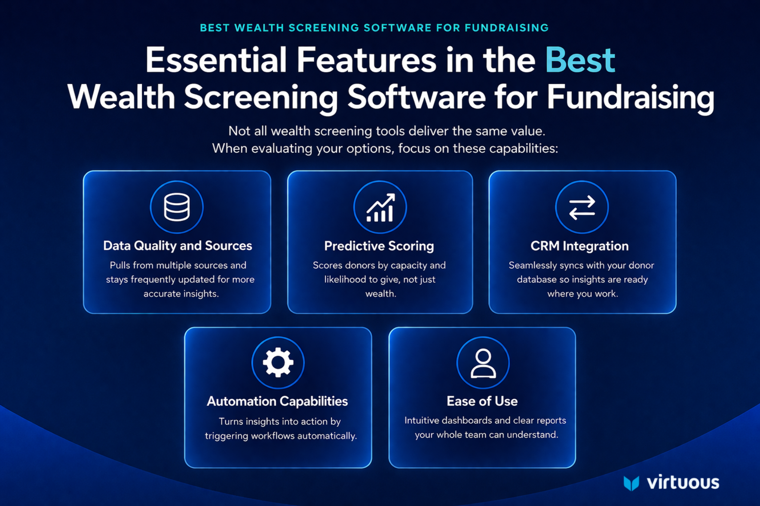
Not all wealth screening tools deliver the same value. When evaluating your options, focus on these capabilities:
Data Quality and Sources
The foundation of any screening tool is its data. Ask vendors:
- Where does your data come from?
- How often is it updated?
- What’s your match rate for typical nonprofit files?
Look for wealth screening software that pulls from multiple sources, including real estate records, SEC filings, Federal Election Commission data, and known philanthropic gifts.
Predictive Scoring
Raw wealth data only tells part of the story. A billionaire who’s never given to charity is less valuable than a millionaire with a history of generous giving. The best wealth screening software for fundraising in 2026 uses predictive models to score donors based on both capacity and likelihood to give.
CRM Integration
Screening data loses value if it sits in a separate system. Prioritize tools that integrate directly with your donor database, pushing insights into individual records where your team can act on them.
Understanding how integrations like DonorSearch work within a CRM helps clarify whether you need a standalone screening platform or an embedded solution. Wealth screening fits into a broader nonprofit technology ecosystem that includes your CRM, marketing automation, and analytics platforms.
Automation Capabilities
Can the tool trigger workflows based on screening results? For example, automatically assigning high-capacity donors to a gift officer or enrolling them in a cultivation sequence. This turns insights into action without manual intervention.
Ease of Use
A powerful tool that nobody uses is worthless. Look for intuitive dashboards, clear visualizations, and reports your team can actually interpret. The best tools make complex data accessible to your whole team, not just your research analyst.
Wealth Screening vs. Prospect Research: Key Differences
| Aspect | Wealth Screening | Prospect Research |
| Scope | Broad, file-wide analysis | Deep dive on individuals |
| Depth | Surface-level indicators | Comprehensive profiles |
| Time Investment | Automated, fast | Manual, time-intensive |
| Best For | Identifying who to research | Preparing for a specific ask |
Wealth screening is the first step. It surfaces names worth investigating. Prospect research is the second step, where you build a complete profile on your top prospects.
Think of screening as casting a wide net. Research is examining your best catches closely.
Understanding the journey from supporter to donor prospect helps clarify where screening fits in your overall cultivation strategy.
How to Choose the Right Wealth Screening Software for Your Team
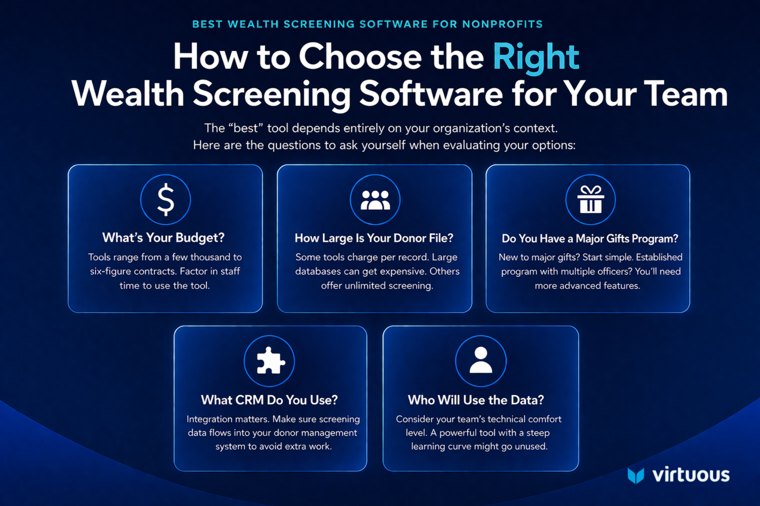
The “best” tool depends entirely on your organization’s context. Here are the questions to ask yourself:
What’s Your Budget?
Wealth screening software ranges from a few thousand dollars annually to six-figure enterprise contracts. Be realistic about what you can invest, and factor in the cost of staff time to actually use the tool.
How Large Is Your Donor File?
Some tools charge per record screened. If you have a massive database, costs can escalate quickly. Others offer unlimited screening for a flat fee.
Do You Have a Major Gifts Program?
If you’re just launching a major gifts effort, start with a simpler tool. If you have an established program with multiple gift officers, you’ll benefit from more sophisticated features.
What CRM Do You Use?
Integration matters. If your screening data doesn’t flow into your donor management system, you’re creating extra work for your team. Evaluate how each tool connects with your existing technology.
Choosing the right CRM for your nonprofit is a foundational decision that affects how well any wealth screening software for nonprofits will serve you.
Who Will Use the Data?
Consider your team’s technical comfort level. A powerful tool with a steep learning curve might gather dust. Sometimes simpler is better.
For Chief Development Officers evaluating these decisions, the key is matching tool sophistication to team readiness.
Maximize Major Gift Potential with Virtuous
Wealth screening data is only valuable if it leads to action. The most effective organizations don’t just screen their files. They build systems that turn insights into personalized outreach at scale.
This is where an integrated approach shines. When screening data lives inside your CRM, you can:
- Automatically assign high-capacity donors to gift officers
- Trigger personalized cultivation sequences based on capacity and engagement
- Track the full journey from screened prospect to closed gift
- Measure which data points actually predict giving behavior
Many nonprofits struggle with chaos and frustration in major donor management. Disconnected systems and manual processes slow everything down.
When you tap into the power of Virtuous Insights (in Virtuous CRM+), you combine wealth screening, donor management, and fundraising automation in one platform. Your team spends less time hunting for information and more time building relationships that inspire generosity.
Ready to see how it works? Schedule a demo to explore Virtuous Insights and discover the hidden potential in your donor file.
Frequently Asked Questions
How much does wealth screening software cost?
Pricing varies widely based on features and file size, ranging from a few thousand dollars annually for basic tools to enterprise-level investments for comprehensive platforms with predictive analytics.
How accurate is wealth screening data?
No screening tool is perfect, but leading platforms achieve match rates of 70-90% depending on data quality. Always treat screening results as directional guidance rather than absolute truth.
How often should we screen our donor file?
Most organizations benefit from a full file screen annually, with ongoing screening of new donors as they enter your database. If you’re using an integrated solution like Virtuous Insights, ongoing screening and workflow triggers can be automated inside your CRM.
Can small nonprofits benefit from wealth screening?
Yes, though the ROI depends on having staff capacity to act on the insights. Even a simple screen can reveal surprising prospects worth cultivating.
What’s the difference between capacity and propensity?
Capacity refers to a donor’s financial ability to give. Propensity measures their likelihood to actually make a gift based on behavioral and philanthropic indicators. The best screening tools account for both.