TL;DR
- Giving hit a record $617.2B in 2025, up 3.0% after inflation. [1]
- Donors fell an estimated 3.6%. [2]
- The biggest nonprofit fundraising trends for 2027 all point to depth, not breadth.
- AI use is nearly universal, but major impact is rare.
As a fundraiser looking ahead to the new year, you probably want to know:
→ Looking ahead: What nonprofit fundraising trends should I know about for 2027?
→ Looking back: And what were the top nonprofit fundraising trends from 2026?
And also: Which trends are actually worth my time, and which should be ignored?
At Virtuous, we help nonprofit fundraisers build deeper donor relationships through responsive fundraising. In this article, we’ll look at 6 nonprofit fundraising trends for 2027 to apply to your new year of fundraising. Along the way, you’ll see some of our research and products referenced.
The problem isn’t you or your team. The world of fundraising has changed. Yet, with the tools now available to listen and respond to every donor, there’s never been a better time to be a fundraiser.
First, a few important data points:
Data pulled in 2026 show us a clear story: nonprofits pulling ahead are those who are investing in depth, not just breadth.
According to Giving USA’s 2026 Report, giving reached $617.2B in 2025, up 5.7% in current dollars and 3.0% when accounting for inflation. [1]
The Fundraising Effectiveness Project (FEP), a collaboration between AFP and GivingTuesday, takes this a step further. They also found that giving increased in 2025…approximately by 5%. But in contrast, donor counts decreased by approximately 3.6%. [2]
Data from the 2026 Virtuous Nonprofit Benchmark Report also backs up this stance: Donor retention is essentially flat at 54.73%. Second gift conversion fell. Yet, donor lifetime value rose nearly 18%.
Hence, the theme: depth, not breadth.
This is the Great Donor Ignore: giving is a deeply personal act, yet generic thank-yous and broad outreach have simply been unavoidable due to a lack of ability to scale outreach. It’s no one’s fault. The tools and methods most teams inherited were built for volume, not for listening. The way out is responsive fundraising: listening and responding to every signal a donor gives to build a deeper relationship and connection.
Now, this data doesn’t mean you should throw new donor acquisition to the curb with abandon. It does, however, mean that if your fundraising strategies are solely focused on bringing new donors into the fold, you may want to take a good look at your retention strategies and donor cultivation.
How do you do this?
With each nonprofit fundraising trend for 2027 below, we’ll explore real ways to put it all into practice.
*A note on timing: Most of the studies in this article were published in 2026 and looked at data in 2025, as is standard for most nonprofit reports.*
6 Nonprofit Fundraising Trends for 2027
Nonprofit Fundraising Trend #1: The Second Gift is the Whole Game
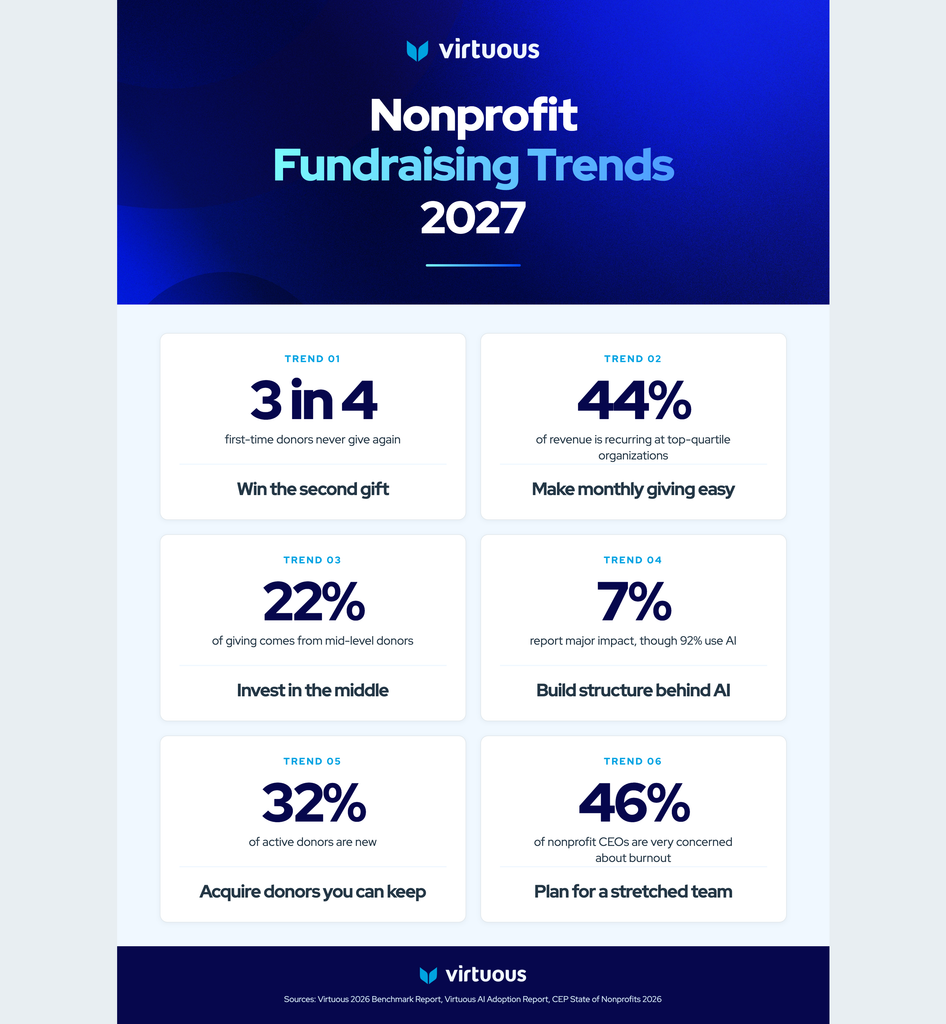
According to data from the Virtuous 2026 Benchmark Report, 3 in 4 first-time donors never come back after the first gift.
That’s Donor Ignore setting in. The first gift gets a receipt, then the donor goes quiet on your end.
But if you consider the act of giving to a nonprofit for the first time…the research it takes and the trust to donate your funds to a new nonprofit…that first gift is truly a special moment.
Your first-time donors have overcome many barriers and have indicated clear belief in your cause.
Nurturing first-time donors and getting them to a second gift is one of the most important nonprofit fundraising trends you can follow for 2027. And the ultimate investment in depth, building on generosity that already exists.
How to Invest in Second Gifts in 2027
1. Let the first gift tell you what to say next. How a donor gave is your first clue about what they care about. A peer-to-peer donor came for a person, an event guest came for an experience, and a tribute giver came for someone they love. Segment first-time donors by that gift source and trigger a different follow-up for each group, so the response matches the reason they gave.
Virtuous CRM+ triggers tasks, emails, texts, and even a printed letter from what the donor just did, so every first-time donor gets a timely, personal follow-up without anyone remembering to send it.
2. Offer a next step that isn’t a gift. Use an automated email to invite new donors to an event, a volunteer shift, or a short survey. A low-pressure step keeps them connected before you ask again.
3. Spot the donors worth a personal touch. Use donor intelligence to predict which donors are likely to give again, so you know how to prioritize personal outreach. Virtuous Insights, our prospect research tool, suggests an ask amount and timing for each donor, so your note lands at the right moment.
Nonprofit Fundraising Trend #2: Let Recurring Giving Do the Retention Work
The Virtuous Nonprofit Benchmark Report studies have seen steady growth in recurring revenue in the years preceding 2026, with 2026 stabilizing rather than growing.
The 771 nonprofits in the Virtuous study averaged 20.96% of their revenue coming from recurring giving. And top quartile organizations actually saw 44%, nearly half of their revenue coming from regular, recurring giving.
M+R’s 2026 Benchmarks point the same way: monthly giving was 27% of online revenue in 2025 (22% at small organizations and 37% at the largest). [3]
As a fundraiser, planning for the year ahead is difficult if you truly don’t know where all of your gifts are coming from. Recurring giving adds an element of structure and planning ahead, which makes it one of the most appealing nonprofit fundraising trends for 2027.
How to Invest in Recurring Giving in 2027
1. Nudge one-time donors to go monthly as they give. Right after someone chooses an amount, offer a monthly option. Virtuous Raise offers recurring nudges driven by your CRM data, right in the moment of giving, so donors see a monthly option as they choose an amount.
2. Watch the health of the program. The Recurring Giving Dashboard in Virtuous Raise puts your active recurring givers, your projected annual revenue, and your new versus lost givers in one place, so you have eyes on all of it.
3. Let monthly donors manage their own gift. In Virtuous Raise, the Unified Donor Portal lets donors sign in with a one-time magic link, update their card or amount, and see their giving history without emailing your team, which means fewer small problems turn into cancellations. Plus, tell them what their ongoing gift makes possible. Donor Impact Updates in the portal let you publish personalized updates right inside each donor’s account.
Nonprofit Fundraising Trend #3: Invest in Mid-level Donors
While recurring giving revenue is important to keep in mind, 2026 data also reveals a large dependency on major donors.
The Virtuous Benchmark Report indicates that major donors supply 67% of giving, mid-level donors 22%, and everyday donors 11%.
Similarly, FEP flags “a growing reliance on fewer, larger gifts.” [2]
And while there is a time and place for major gifts, a portfolio balance with such a high concentration on major donors is risky. It means that one or two lapsed relationships could completely swing your year.
Mid-level donors are the natural next step. By the 2026 Virtuous Nonprofit Benchmark Report’s measure, which counts a donor’s cumulative giving across the year rather than any single gift, they supply 22% of giving. These donors have already shown real commitment, and they’re ready for a closer relationship with your nonprofit.
Growing this group spreads your revenue across more relationships, so no single donor decides how your year goes. That makes mid-level giving one of the nonprofit fundraising trends for 2027 worth acting on early.
How to Invest in Mid-Level Donors in 2027
1. Find the donors who are close. Look for donors giving below their potential. Virtuous Insights shows a suggested ask amount and an annual capacity range for each donor, so you can see who’s ready for more.
2. Check your monthly donors. Giving $100 a month adds up to $1,200 a year. That often puts a donor in a nonprofit’s mid-level range.
3. Give each donor a simple plan. For every mid-level donor, set one next step and a light schedule of personal touches, such as a call, a note, or an invitation to see your work. That’s the job of Virtuous Momentum, our AI portfolio management platform. It builds a plan for each donor from their giving and engagement. You review and confirm it before anything goes out. We’ll get into how in the next trend.
Nonprofit Fundraising Trend #4: Build the Structure Behind Your Nonprofit’s AI
The Virtuous AI Adoption Report surveyed 346 organizations in December 2025 and found that 92% of nonprofits use AI but only 7% reported major impact from their AI use at that time.
Along these lines, 81% of organizations use AI individually and on an ad hoc basis, while only 4% have documented workflows. And 47% have no governance policy in place.
This means it’s time to move AI from a personal shortcut to a team practice. Using AI more isn’t exactly the answer. Most teams already use it. The gap is in how it’s set up, shared, and checked. Setting up that structure early gives every other nonprofit fundraising trend for 2027 on this list a stronger footing.
How to Invest in AI for Your Nonprofit in 2027
1. Pick one workflow and start there. Choose one repeatable task, such as first-time donor thank-yous or pre-call donor briefs. Run it for a quarter before adding more. A narrow pilot teaches you more than a broad rollout.
2. Draft with AI, send as a person. Let AI write the first version of donor messages, and have a fundraiser edit and own every one before it goes out.
Want a head start on steps 1 and 2? The Virtuous AI Adoption Report shows how 346 nonprofits are using AI today and where the gaps are, so you can see how your team compares before you build your own workflow.
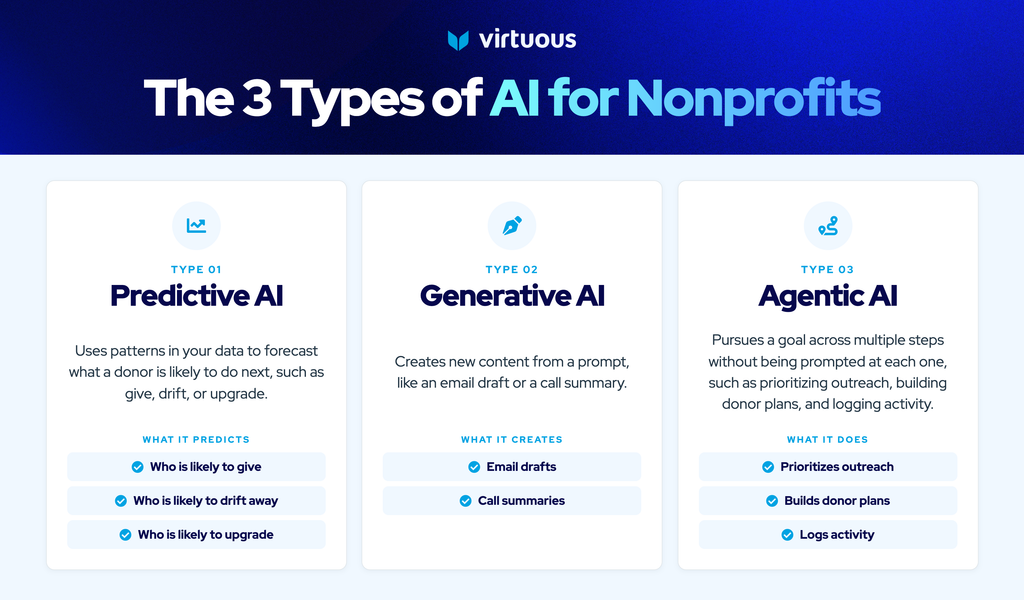
3. Explore agentic AI for your nonprofit. AI comes in three layers that build on each other:
- Predictive AI uses patterns in your data to forecast what a donor is likely to do next, such as give, drift, or upgrade.
- Generative AI creates new content from a prompt, like an email draft or a call summary.
- Agentic AI pursues a goal across multiple steps without being prompted at each one, such as prioritizing outreach, building donor plans, and logging activity.
Most teams stop at generative. Once you’re comfortable there, begin exploring agentic tools.
Give that tool a clear goal, like “every mid-level donor hears from us each quarter,” and set the rule that a person signs off on anything a donor sees.
Virtuous Momentum’s AI Engagement Planner drafts a personalized outreach plan for every donor in a portfolio, using giving history, behavioral data, and external signals. You review the plan, refine it, and confirm it, and then Momentum creates the actual tasks, emails, and reminders. Each morning, it emails your team a short list of donors to contact, with the reason behind each one. It drafts the outreach in your fundraiser’s voice, and logs your calls, emails, and meetings back to your CRM. Your fundraiser reviews and sends every message, so a person stays at the helm, not merely in the loop.
4. Measure the donor outcome, not just time saved. Track something donors would notice, like how fast new donors hear from you or how many make a second gift. If those don’t improve, the time you saved isn’t paying off.
Nonprofit Fundraising Trend #5: Acquire Donors You Can Keep
New donors made up 32.06% of active donors in the Virtuous Benchmark Report, about the same as the year before. M+R’s 2026 Benchmarks found new donors accounted for 31% of online revenue. [3]
A high share of new donors can mean healthy growth, or it can mean you’re replacing donors who left. Your retention numbers tell you which. Judge acquisition by how many new donors stay, not just how many arrive. For 2027, that shift from counting new donors to keeping them is one of the more practical fundraising trends to plan around.
How to Invest in New Donor Acquisition in 2027
1. Track what happens after the first gift. For each campaign, form, or event, count how many new donors give again, then put more effort into the sources that produce second gifts. Virtuous Analytics has dashboards for retention and campaign results, so you can click from a number to the donors behind it.
2. Start with people who already know you. Newsletter subscribers, event guests, and volunteers are closer to giving than strangers are. Invite the ones who’ve shown interest to make a first gift.
3. Win back lapsed donors before buying new names. Pull a list of people who gave in past years but not this year, and send each a short personal note. Virtuous Analytics has a pre-built LYBUNT report template for exactly this list, and Virtuous Insights can flag which lapsed donors are most likely to come back.
4. Test your first ask. A/B testing is built into Virtuous Raise and included in every subscription. Compare two versions of a donation page, pick your winning metric, and let traffic decide. Then check which version’s donors came back for a second gift.
Nonprofit Fundraising Trend #6: Build a Sustainable Plan for Your Team
Every one of these nonprofit fundraising trends for 2027 takes time and energy. CEP’s 2026 State of Nonprofits report describes “simultaneous and compounding pressures” on the sector. CEO concern about their own burnout rose to 46%, up from just under 30% the year before, and leaders report more trouble getting foundation funding. [5]
A plan your team can’t run won’t help you, so build 2027 around the capacity you actually have. Start small and add more as things stick.
How to Invest in Your Team in 2027
1. Pick one goal for the first quarter. Choose the area with the most room to grow, such as second gifts, recurring giving, or mid-level donors.
2. Automate the routine. Receipts, new-donor tasks, and thank-you emails can run on triggers in Virtuous CRM+. That frees up your staff’s time for the human parts of your job that can’t be automated.
3. Put your numbers where the team already works. Virtuous Analytics has turnkey nonprofit dashboards that refresh automatically. You can even embed live reports in your CRM or an email, so no one has to pull them by hand.
Putting Nonprofit Fundraising Trends for 2027 Into Practice
At the end of the day, none of these nonprofit fundraising trends for 2027 we covered today are helpful unless you know where to start.
Pick one trend and begin there, whichever is closest to a problem you already feel. If new donors rarely come back, start with the second gift. If a few major donors carry your revenue, start with your mid-level file. Set one goal for the first quarter, then check your numbers when it ends.
And whichever trend you choose, a goal is easier to keep once you’ve said it out loud. Share your first-quarter goal with your team so everyone can check in on it.
You can also use the Virtuous Benchmark Health Check to get customized next steps based on your retention, average gift size, and recurring giving revenue. Just plug in those 3 numbers for quick results.
FAQs About Nonprofit Fundraising Trends for 2027
How are nonprofits doing in 2026?
Mixed: dollars are up, but donors and capacity are strained. Giving hit a record $617.2B in 2025 [1] and grew an estimated 4.3% in Q1 2026 [4], while donor counts fell 3.6% in 2025 [2] and 0.8% in Q1 2026 [4]. CEP also found 39% of the nonprofits it surveyed reporting a deficit and 46% of CEOs very concerned about their own burnout. [5]
What were the top nonprofit fundraising trends in 2026?
The fundraising reports published in 2026 point to one pattern: depth over breadth. Giving reached a record $617.2B in 2025 [1] while donor counts fell [2], and the Virtuous Benchmark Report found donor lifetime value up nearly 18% even as second-gift conversion dropped. AI use also became nearly universal, with 92% of nonprofits using it but only 7% reporting major impact.
What are the top nonprofit fundraising trends for 2027?
This article covers six nonprofit fundraising trends for 2027: the second gift, recurring giving, mid-level donors, building structure around AI, acquiring donors you can keep, and building a sustainable plan for your team.
What is a good donor retention rate for nonprofits?
It depends on who is measured. FEP’s sector-wide data put overall retention at 43.3% in 2025 [2], while the 771 mid-sized US nonprofits in the Virtuous Benchmark Report had an overall retention rate of 54.73%.
How many first-time donors give a second gift?
About one in four. The Virtuous Benchmark Report found that 25.84% of first-time donors gave again within 12 months, and top-quartile organizations reached 37.9%.
What is agentic AI in nonprofit fundraising?
Agentic AI in fundraising pursues a goal across multiple steps without being prompted at each one, such as prioritizing donor outreach, building donor plans, and logging activity. It builds on predictive AI, which forecasts donor behavior, and generative AI, which creates content, and a person should still approve anything a donor sees.
Where should a nonprofit start with these fundraising trends?
Pick the fundraising trend closest to a problem you already feel, set one goal for the first quarter, and check your numbers when it ends. If new donors rarely come back, start with the second gift. If a few major donors carry your revenue, start with your mid-level file.
[3] https://mrbenchmarks.com/fundraising/
[5] https://cep.org/report-backpacks/state-of-nonprofits-2026/