TL;DR
- 92% of nonprofits use AI, but only 7% report major impact
- The gap isn’t budget or tech skill, it’s strategy and structure
- Most are stuck in the “efficiency plateau,” doing the same things faster
- The 7% fixed broken systems first, created governance, documented workflows, and measured results
- AI amplifies whatever system it touches, broken or not
- The dividing line won’t be who uses AI, it will be who builds it into infrastructure intentionally
When I first began experimenting with artificial intelligence in nonprofit fundraising around 2017, it did feel revolutionary. But it was a revolution hidden behind complexity.
The models were powerful, yet expensive, technical, and slow to deploy. We were working with predictive systems that tried to forecast donor behavior or prioritize portfolios, but they required specialists, clean data, and patience. There were no viral demos, no conversational interfaces, no headlines declaring that intelligence had become abundant.
What we felt then was not hype – it was a quiet recognition that something fundamental was shifting beneath the surface of our work, even if most of the sector could not yet access it.
Back then, the barrier was skepticism. Today, it is saturation.
In The 2026 Nonprofit AI Adoption Report, our latest benchmark study of 346 nonprofit organizations, 92% report using AI in some capacity. In less than two years, generative AI has moved from curiosity to default.
The experiment phase is over. Nearly everyone is trying something.
And yet, in sharp contrast, only 7% report major, mission-level improvements as a result.
That number has stayed with me because it isolates the core leadership test of this moment – whether we are willing to rethink how we work, or merely accelerate what already exists.
92% adoption. 7% transformation.
The gap between those numbers is not about technical sophistication. It is not about budget. It is not even about frequency of use. Many organizations are using AI every day.
The difference is philosophical and structural. It is about how leaders think about work, and what they are willing to change in order to make AI meaningful.
2 Fundamentally Different Approaches to AI
Over the past several years, I have watched organizations approach AI in two fundamentally different ways:
The first approach treats AI as acceleration.
The second treats it as evolution.
The first produces the efficiency plateau.
The second produces a compounding advantage.
Most nonprofits today are living in the efficiency plateau. In our study, 79% reported small to moderate improvements. They are drafting faster. Researching faster. Producing more content in less time. That is not trivial. In a sector stretched thin by rising donor expectations and expanding data complexity, speed has value.
But speed is not capacity.
One fundraising leader described it candidly: “Everyone on the team uses AI for drafts and research. They are definitely faster. But if you ask whether the organization has fundamentally changed what it is capable of accomplishing, the answer is no. They are doing the same things more efficiently.”
This is the illusion AI creates. It makes motion visible. It makes productivity measurable. It makes teams feel modern.
But acceleration without alignment rarely produces relief. It can also produce exhaustion. What AI does not automatically do is improve strategy, coherence, or judgment. It magnifies whatever system it is introduced into. If that system is fragmented, it fragments faster. If it is thoughtful and aligned, it scales thoughtfulness.
I often say something that makes people uncomfortable, but it is true: If you have a broken fundraising practice and you put AI on top of it, you will have a broken AI fundraising practice.
AI doesn’t rescue broken systems. It accelerates them. The organizations in the 7% seeing major impact knew they had to strengthen their strategy before they strengthened their tools.
7 Patterns Behind the 7% of Nonprofits Turning AI Into Mission-Level Impact
When we looked more closely at the organizations reporting major improvements, patterns emerged. None of them were glamorous. But all of them required discipline.
1. Move Beyond AI as a Personal Shortcut
The nonprofits most tapping into AI to revolutionize their fundraising stopped treating AI as a personal shortcut. 81% of nonprofits in our study use AI in an ad hoc, individual way.
Prompts live in private documents. Discoveries are not shared. Knowledge leaves when staff leave. Only a small fraction have documented workflows.
On the surface, this looks like widespread innovation. In practice, it is scattered experimentation.
The organizations pulling ahead made a different decision. They treated AI as infrastructure. Infrastructure changes how work flows across teams. It requires clarity about ownership. It forces leaders to ask which decisions remain human and which processes can be supported by models. It invites coordination rather than isolated experimentation.
That shift alone alters the trajectory of AI adoption.
2. Fix What’s Broken Before Adding AI
The high-impact organizations confronted what was broken before they layered on intelligence. This is the part no one likes to discuss. AI exposes inconsistency.
If your donor strategy is reactive, AI will help you react faster.
If your data is messy, AI will surface messy outputs at scale. If your donor communications are inconsistent and unclear, AI will generate articulate versions of that confusion.
The leaders in the 7% did not rush to automate chaos. They clarified philosophy. They cleaned data. They defined what a meaningful donor journey looked like. They aligned on what success meant.
Only then did they introduce AI as an amplifier.
That sequence matters.
3. Establish Clear AI Guardrails
Once they fixed broken systems, these organizations established clear AI guardrails.
Nearly half of the nonprofits in our study have no AI governance policy. Ironically, that absence does not create freedom. It creates confusion, hesitation, and hidden risk. Staff are unsure what is allowed, especially when donor data or public communication is involved. Leadership cannot confidently encourage broader use when the boundaries are undefined.
The organizations seeing major impact did not create heavy compliance frameworks. They created clarity. Simple statements of what AI use is encouraged, what requires review, and what is prohibited.
But more importantly, they made explicit how those boundaries reflected their values.
Governance, when done well, does more than reduce risk. Governance clarifies what the organization stands for in an age of automation. It reduces fear and enables responsible scaling. It allows teams to move together rather than cautiously apart.
4. Document AI Use Cases
Next, they documented what worked.
This may be the most underestimated practice of all. The difference between individual experimentation and organizational capability is documentation.
A shared file of proven prompts. A defined workflow for portfolio prioritization. A captured process for drafting and refining donor communication.
Without documentation, you have isolated brilliance. With documentation, you have a compounding advantage.
Documentation transforms AI from a clever assistant into a repeatable engine for growth.
5. Measure What Works
Documenting successful use cases of AI ensures collaboration; measuring these successes verifies that the time and use is well spent.
The nonprofits in the 7% measured something. Not everything. Something.
Time saved in prospect research or portfolio review. Response rates on personalized outreach. The number of donor plans updated proactively rather than reactively. This measurement created feedback loops. Feedback loops created learning. Learning created refinement. The feedback loop continues indefinitely.
Most organizations rely on intuition. AI feels helpful. Drafts seem better. Work seems faster. But without evidence, there is no compounding insight.
The organizations in the 7% started where the risk was low and the return was clear. They measured small, early gains and refined their processes before moving into higher-stakes applications. Over time, those modest feedback loops created confidence, and confidence created momentum.
Progress became visible and defensible rather than assumed.
6. Keep Your AI Human-First
Finally, and perhaps most importantly, they reallocated human energy intentionally. They did not use AI to avoid the hard parts of fundraising. They used it to protect them. They allowed AI to summarize, prioritize, draft, and surface signals. Then they reinvested the saved time into relationship strategy and meaningful engagement.
They did not celebrate sending more emails. They celebrated having better conversations.
That distinction may define the next decade of nonprofit leadership.
7. Use AI Fundraising Tools That Actually Make the Most Impact
We are long past the moment where simply “using AI” is impressive.
The real question now is this: Is it helping you build deeper connection? More trust? More meaningful relationships?
In my book, The Generosity Crisis, I argued that philanthropy’s greatest challenge is not a revenue problem. It is a connection problem. If generosity is the manifestation of connection, then AI must be evaluated through one lens:
Does it deepen relationships, or does it simply automate transactions?
That distinction matters.
Virtuous Momentum: From Efficiency to Relationship Intelligence

Many AI tools promise faster emails, better segmentation, or improved predictions. Those are helpful, but they are incomplete if they do not ultimately strengthen connection.
The right AI tools should help fundraisers:
- Spend more time in meaningful donor conversations
- Identify supporters who are drifting before they lapse
- Unlock mid-level and major gift potential
- Personalize outreach at scale without losing authenticity
Virtuous Momentum is our AI-powered fundraising assistant designed to help gift officers prioritize their day, draft thoughtful outreach in their own voice, surface next steps, and manage donor plans more intelligently. And with more speed.
The goal is not more activity. The goal is better focus, clearer priorities, and stronger relationships.
→ Schedule a demo to see how Virtuous Momentum can transform your daily fundraising.
Virtuous Insights: Predicting Generosity by Measuring Connection

For years, fundraising relied heavily on wealth as the primary signal of potential. But generosity is not simply a function of capacity. It is a function of connection.
This is where predictive intelligence matters.
Virtuous Insights uses machine learning to combine first-party CRM data with external signals to help nonprofits identify:
- Donors at risk of lapsing
- Supporters ready to upgrade
- Emerging major gift prospects
- Likely planned givers
The purpose is not to reduce donors to scores. It is to see them more clearly so we can steward them more thoughtfully.
To see Virtuous Insights in action, schedule a demo now.
Take Your Nonprofit’s AI Use From Experiment to Infrastructure
AI is moving from experiment to infrastructure. That shift is already underway, whether leaders acknowledge it or not.
The only open question is whether organizations will shape that infrastructure intentionally or allow it to form accidentally through ad hoc behavior.
We are still in a fluid moment. Organizational patterns are not yet fixed. Teams are still exploring. Cultural norms around AI are still forming. That creates opportunity. Once habits solidify, they become harder to reverse.
The organizations that will pull ahead are not the ones using AI the most. They are the ones willing to examine how they work, clarify what they believe about fundraising, and build simple structures that turn intelligence into shared capability.
92% of nonprofits now use AI. That is no longer the headline.
The real story is the 7% who chose to rethink their systems rather than simply accelerate them.
Will you join them?
Next Steps to Continue Your Use of AI
Curious where this data comes from?
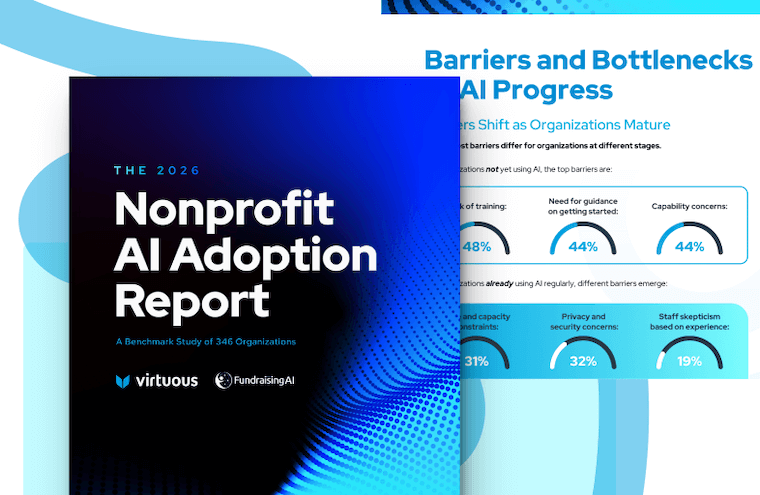
Download the 2026 Nonprofit AI Adoption Report now to discover:
→ Why 92% of nonprofits are using AI, yet only 7% report major mission-level impact
→ The six structural moves that unlock transformation instead of simply increasing speed
→ Why 47% of organizations operate without a formal AI governance policy, and a practical template to build one rooted in your values
→ Why only 4% have documented AI workflows, and how to move from scattered experimentation to institutional capability
→ Why 65% remain stuck in reactive, individual AI use, and what it takes to build coordinated, organization-wide advantage
Download the 2026 AI Adoption Report now.
FAQs
What percentage of nonprofits are using AI today?
According to the 2026 Nonprofit AI Adoption Report, 92% of the 346 nonprofits surveyed report using AI in some capacity.
Why are so few nonprofits seeing major impact from AI?
Only 7% report mission-level improvements because most organizations are using AI to speed up existing work rather than rethinking their systems and strategies. The gap is philosophical and structural, not technical or budget-related.
What is the “efficiency plateau”?
The efficiency plateau describes what happens when nonprofits use AI purely for acceleration, like drafting faster and researching faster, without changing what they’re capable of accomplishing. 79% of nonprofits in the study reported only small to moderate improvements, which reflects this pattern.
What should a nonprofit fix before implementing AI?
Organizations should clarify their donor strategy, clean their data, and align on what success looks like before layering on AI. AI amplifies whatever system it’s introduced into, so broken processes will only produce broken outputs faster.
Do nonprofits need a formal AI governance policy?
Yes. Nearly half of nonprofits have no AI governance policy, which creates confusion and hesitation among staff. Even a simple set of guidelines outlining what’s encouraged, what requires review, and what’s prohibited can unlock more confident and consistent AI use.
Why is documenting AI use cases so important?
Documentation is what turns individual experimentation into organizational capability. Without it, effective prompts and workflows stay siloed with individuals and leave when staff leave.
How should nonprofits measure AI success?
Start by measuring something simple, like time saved in prospect research, response rates on outreach, or donor plans updated proactively. These small feedback loops build compounding insight and momentum over time.
What does “human-first AI” mean for fundraisers?
It means using AI to handle summarizing, drafting, and prioritizing so that the time saved gets reinvested into deeper donor relationships and better conversations, not just more output.
Do smaller nonprofits have a disadvantage with AI adoption?
Not necessarily. The study found that smaller organizations sometimes achieve moderate impact at higher rates because they can align around a shared approach faster. Complexity, not budget, is often the bigger barrier.
What’s the difference between treating AI as acceleration vs. evolution?
Acceleration means doing the same things faster, which leads to the efficiency plateau. Evolution means rethinking how work flows, what decisions remain human, and building AI into your infrastructure for compounding, mission-level advantage.