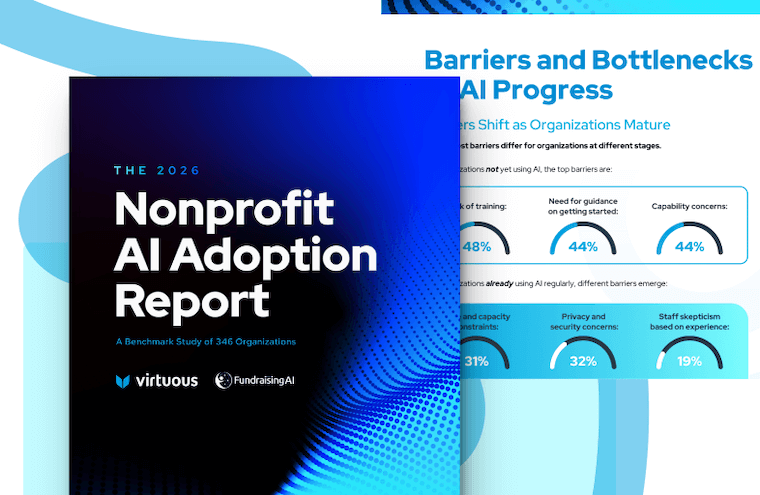
Your nonprofit is most likely using AI, but do you ever find yourself wondering if you and your team use it well? Or how your use of AI compares to other nonprofits? We recently completed a benchmark study to answer exactly those questions: The 2026 Nonprofit AI Adoption Report.
Throughout December 2025, we surveyed 346 nonprofit organizations about their real AI usage in fundraising work. Not the lofty 5-year goal, but what is actually happening day-to-day.
The research revealed something unexpected: a massive disconnect between…
→ How many organizations are using AI
→ And how many are actually seeing it transform their work
Download the full 2026 Nonprofit AI Adoption Report here to see the breakdown.
What the Adoption Numbers Showed
92% of nonprofits are now using AI in some capacity.
That represents remarkable adoption for a technology that barely existed in its current form two years ago. Nearly every organization we surveyed has moved past the “should we try this?” phase and into active experimentation.
Teams are drafting emails faster. They are generating content ideas. They are using AI for research and brainstorming. The tools are accessible, the learning curve is manageable, and these gains are tangible.
However, the adoption metrics only reveal part of the picture.
The Story Revealed by the Numbers: A Sector Still Experimenting
Only 7% of those organizations report major improvements in their ability to achieve their mission.
Consider that contrast for a moment. 92% adoption. 7% transformation.
We call this the AI adoption paradox.
This represents a substantial gap separating experimentation from meaningful outcomes.
The vast majority of organizations are hitting what our research identifies as an efficiency plateau. They are accelerating existing workflows without fundamentally expanding what they can accomplish as a team, such as scaling personalized donor outreach or automating manual steps in your team’s internal workflows.
Organizations are tending to view AI as a collection of tools instead of an evolution of how work gets done in the first place.
One fundraising leader we surveyed described this perfectly: “We’ve been using AI for over a year now. Everyone on my team uses ChatGPT for drafts and research. We’re definitely faster. But if you asked me if we’ve fundamentally changed what we’re capable of as an organization, I honestly don’t think so. We’re just doing the same things more efficiently.”
The Obstacles Holding Teams Back
The obstacles shift as organizations mature, and that pattern showed up clearly in our data.
Organizations not yet using AI cite:
- Lack of training (48%)
- Need for guidance on getting started (44%)
- Capability concerns (44%)
Organizations already using AI daily face entirely different challenges:
- Time and capacity constraints (31%)
- Privacy and security concerns (32%)
- Staff skepticism based on experience (19%)
The root issue extends beyond these surface-level barriers: 47% of organizations have no AI governance policy. Additionally, 81% are using AI on an ad hoc basis without any documentation of what actually works.
Consider what that means in practice. Multiple people on the same team are solving identical problems in isolation. Successful approaches remain invisible to others. When someone leaves, their knowledge walks out the door. New staff start from zero instead of building on what the organization has already learned.
One responder articulated this challenge clearly: “AI needs to be integrated more across systems. Right now, it’s hard to automate because different AIs are working in different systems.”
What Separates the 7% Seeing Real Transformation
The organizations achieving substantial outcomes are approaching implementation differently.
These organizations have stopped viewing AI as an individual’s productivity enhancement. Instead, they have embedded it into their team’s operational rhythms.
The investment required proves more modest than most organizations assume:
- A centralized document capturing proven prompts and approaches
- A single-page acceptable use policy created in one focused meeting
- Basic measurement systems to track outcomes across departments
- Adopting the right tools to form an integrated system
They represent foundational decisions that take days to establish but create compounding value over time.
One responder captured the approach simply: “Create Efficient Workflows and Document Processes.”
Organizations that have started capturing workflows and documenting their approaches describe accelerating returns. New staff get trained quickly. Everyone uses proven approaches. Teams iterate rather than starting from scratch.
An Important Moment for AI & Philanthropy
We’re at a unique moment…with most nonprofits having implemented AI and few using it to fully change their everyday practices.
It’s a moment that won’t last forever, but we believe it is an important one.
With everyone still learning, it’s an easy time to step in and lead your team towards operational changes that impact everyone’s day-to-day workflows for the better…using AI.
→ Inside the full report, we detail the 6 foundational steps that distinguish organizations achieving real transformation from those stuck at the efficiency plateau.
→ We have also developed ready-to-use templates for governance policies and acceptable use guidelines, so teams can establish these foundations without building from scratch.
Download the full 2026 Nonprofit AI Adoption Report
See AI-Powered, Responsive Fundraising in Action
At Virtuous, we’ve built AI directly into our fundraising tools because we understand that structure and purpose matter just as much as capability.
Virtuous Momentum helps gift officers start each day knowing exactly which donors to prioritize, draft personalized outreach in seconds, and manage growing portfolios without sacrificing relationship quality. One gift officer shared: “[Virtuous Momentum] keeps me going, gives me a plan in the morning, allows me to plan for those donor phone calls that I need to make.”
Another user set aside six hours for a recent email campaign, expecting to need all of that time. With Momentum, the entire process took 20 minutes. As they described it: “For a recent email campaign, I set aside six hours, expecting to need all of that time, but with [Virtuous] Momentum the entire process only took 20 minutes. The ease and efficiency were incredible.”
Schedule a demo of Virtuous Momentum
Virtuous Insights, available within Virtuous CRM+, uses predictive machine learning to surface high-value prospects, identify donors at risk of lapsing, and recommend the right ask amounts based on wealth and engagement data. The tool combines your CRM data with third-party signals to reveal patterns that static reports simply cannot capture.
Both products are designed around the same principle: AI should strengthen donor relationships and expand what your team can accomplish, not simply accelerate what you are already doing.
Schedule a demo of Virtuous Insights
We remain committed to helping fundraising teams navigate this transition thoughtfully. The research reveals clear patterns. The pathway forward is practical. Organizations that establish structure now will define what becomes possible for their teams in the years ahead.