TL;DR
- 12 practical end of year giving ideas covering goals, donor segmentation, appeals, your giving page, channels, matching gifts, GivingTuesday, major donor outreach, and January follow-up.
- Start before the season does. Goals, segments, automation, and giving page fixes all go better when they’re settled early.
- Segment by giving level. General, mid-level, and major donors each need a different ask, not the same email.
- Don’t stop at the thank-you. Only 25.84% of first-time donors give again, so your January plan matters as much as your December appeal.
End of year giving is the heaviest stretch of your fundraising year. But we all know it’s also one of the toughest times to focus and get creative.
By the time it starts, you’ve already been running what feels like a full-out sprint for months. The fall event. The grant deadline. The board report. Three people covering the work of eight, and then December casually knocks on your door expecting your single biggest fundraising push of the year.
So the appeal gets written the same week you’re supposed to be calling your most loyal donors. And the giving page you meant to rebuild in September never got rebuilt, so it’s the one your December traffic lands on.
At Virtuous, we believe end of year giving doesn’t have to look quite so…end-of-worldish. That’s why we’ve put together these 12 end of year giving campaign ideas, so you have a place to start when all creativity feels like it’s been snuffed out.
Along the way, we’ll talk about top-tier fundraising tools you can use to make end of year giving that much easier.
Let’s get started.
Why Donors Give More During End of Year Giving Season
Typically, donors tend to give more during end of year giving season. Here’s why:
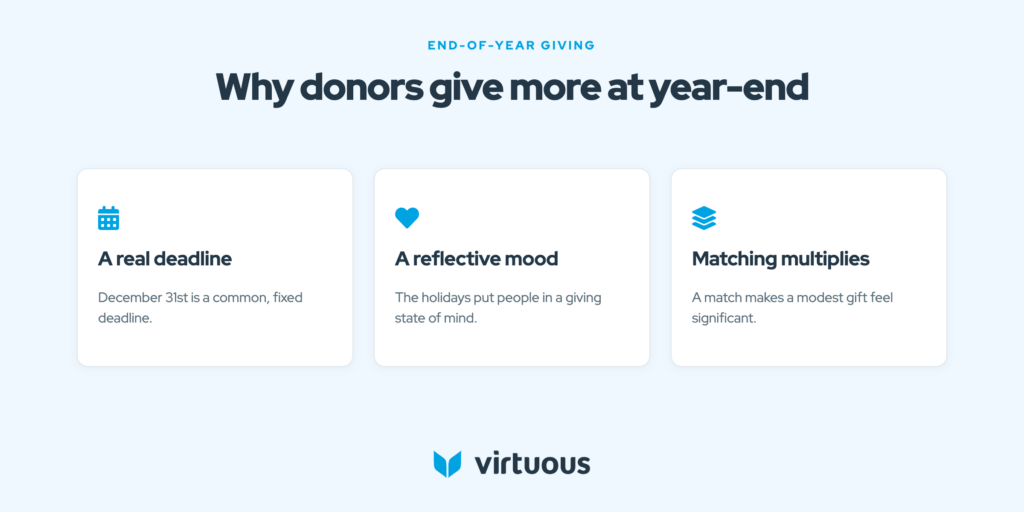
- A real deadline. December 31 creates urgency you don’t have to invent. Tax benefits are rarely the top driver, but the date is fixed and everyone knows it.
- A reflective vibe. The holidays already have people taking stock of their year, including where their money went and whether it mattered.
- Multiplication. A match makes a modest gift feel significant, which is why matching shows up in nearly every year-end fundraising campaign worth copying.
So, here are 12 ideas you can use for your end of year giving campaigns.
12 Ideas for End of Year Giving Campaigns
1. Set a Goal Your Team Can Track
Set a clear goal for your team.
Something like this is:
$50,000 between October and December, with four lead gifts in the five-figure range and 100 new email subscribers by January 1.
Give every channel its own target. Your email file and your direct mail file behave nothing alike, and one blended number hides which one carried you.
Then, look backward. Which segments engaged last December? Which channels produced? You’re beginning to build a plan for next year as you do this.
2. Sort Your Donors Into Three Giving Levels
If you write to one undifferentiated audience, you’ll end up reaching nobody.
General donors. Typically your largest group by count. Smaller gifts, less often. They still deserve a story and the simplest path to give.
Mid-level donors. In the 2026 Virtuous Nonprofit Benchmark Report, we define mid-level donors as those giving $1,000 to $9,999 across the year. In our study, mid-level donors account for 21.75% of revenue. They’re often the most under-served group in fundraising, but many have major gift capacity.
Major donors. In our report, we define major donors as those giving $10,000 or more annually, and they account for 67.09% of all revenue. There’s so much giving potential with major donors, but it’s always good to have a healthy portfolio balance not overly concentrated on major donors.
Where you draw the dollar lines is your call. A major gift at one organization is mid-level at another. And look past gift size, because giving frequency and channel preference belong in your donor segmentation work too.
With automation and tags, Virtuous CRM+ builds your donor segments every day. Query on giving totals, largest gift size, or most recent gift, and it refreshes nightly.
3. Write a Different Year-End Appeal for Each Level
Unique messaging is what makes segmentation pay off.
Often, a general donor gets the story and a low-friction gift option. A mid-level donor gets a step up anchored to what they gave last time. A major donor gets a project, an outcome, and a number.
Don’t skip the people who already gave this year. December is a good moment for a second gift, as long as you name the first one inside the ask.
Virtuous Insights is the predictive intelligence engine inside CRM+. It surfaces a suggested gift amount and capacity range per donor, plus likelihood indicators for recurring and major giving. For high-capacity donors, it tells you to leave the ask amount open rather than capping what they might have given.
And when it comes to giving pages, Virtuous Raise offers responsive ask arrays that adapt suggested amounts to each donor’s giving history, so a $500 donor doesn’t land on a form that starts at $25.
4. Build Your Automation Before the Season Starts
Year-end planning works best when it starts early, somewhere around the middle of the year, which gives you room to gather momentum long before December. Automation is the piece of that most worth front-loading.
Often, teams go looking for end of year giving automation help in the second week of December. But this is definitely ont the best week to be building anything.
Whatever you set up ahead of time is work nobody has to do by hand during the sprint.
- Gift confirmations.
- Segmented thank-yous.
- Task reminders for the calls that need a human.
- Re-engagement for lapsed donors.
Then test it with a real gift before the appeals go out. Send yourself five dollars and watch what happens. Then hand it to someone who didn’t build the automation workflows and have them try the same thing.
5. Fix Your Giving Page Before You Send Traffic To It
When someone lands on your donation page during end of year giving season, that in and of itself is a huge win. It means the work you’ve done your end of year giving campaign got them to a place where they’re feeling ready to participate in your mission.
Here are some tips to make sureonce a donor lands on your donation page, they stay there!
Keep the form simple. Name, email, payment. Everything else can wait for the confirmation page.
Check the phone experience first. Most December traffic arrives on one. In the 2026 Virtuous Nonprofit Benchmark Report, the average online gift is $114.90, a bit under the overall average gift of $136, which we attribute largely to digital donors entering at lower amounts.
Lead with a story, above the form. People give to people.
Offer monthly at checkout. Not in a follow-up a week later. Recurring giving captured in December pays out for the next twelve months.
And whatever you change, change one thing at a time so you can tell what made the difference.
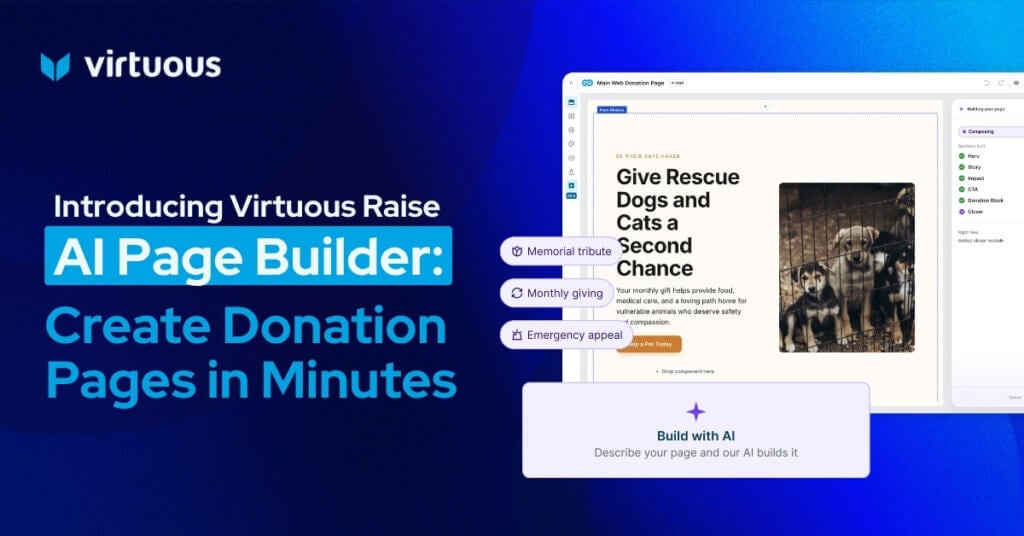
The Raise AI Page Builder generates a complete donation page from a plain-language prompt, something as short as build an urgent appeal for winter heating assistance. It works from a Knowledge Base you fill with your mission statement, brand voice, and your own website content, so the copy sounds like your organization. You can refine it by chat, or edit any module by hand.
6. Give Every Channel a Job
Email carries the volume. Multipel contact points can really pay off here, especially to your most loyal donors, who typically don’t mind hearing from you.
Direct mail earns its cost with more than older donors. Pair every drop with a matching email and two channels start working as one campaign.
Social reminds people who already like you that you exist. If budget is tight, retarget your own list and site visitors in the final week rather than chasing cold reach.
Text is your most direct line, which is exactly why it’s easy to overdo. Save it for the final week, get consent first, and treat it as reinforcement.
Our end-of-year giving playbook goes channel by channel with subject line examples, a direct mail checklist, and SMS guidance.
7. Put a Real Match in Front of People
A match makes a gift feel larger and creates a deadline that isn’t arbitrary.
Corporate matching. Many employers match employee gifts, some at better than dollar for dollar. Most donors have no idea whether their company participates, so telling them is often all it takes to claim money that was already sitting there.
A donor-funded match. One supporter funds the pool. Everybody else’s gift doubles.
A challenge grant. Ask a major donor to commit $50,000 on the condition that everyone else collectively raises $100,000 by December 31, then put their name on it in the announcement. A named person betting on your community tends to pull harder than an anonymous pool.
Promote it everywhere and show live progress. A thermometer that visibly moves does more than a subject line that shouts.
8. Tell One Story and Put the Donor Inside It
You need one story, told well, from enough angles that it doesn’t wear thin by the 20th. And it should answer the question sitting in the back of every reader’s mind: why should I give to you?
Get concrete about the outcome. “This changes lives” is a sentence your donor has skimmed a hundred times. “Your $180 keeps one family’s heat on through February” is a sentence they can picture.
Put the donor in the sentence. We served 400 more meals last winter, and You served 400 more meals last winter carry identical information and describe two pretty different relationships. Interviews with real people, shared with permission and checked for accuracy, tend to resonate more than a well-written statistic.
Then let the ask do its job. Name an amount and a date, repeat it two or three times, and cut anything that needs a second read.
9. Run a Countdown That Earns Its Urgency
Urgency works well, but keep in mind that manufactured urgency costs you trust. And end of year giving hands you the most legitimate deadline in fundraising, free of charge.
One outcome a day. Pick a two-week stretch and publish a single story or number each day, attached to the gift that made it possible.
A visible gap. Weekly updates on the distance between where you are and where you need to be. The gap tends to motivate better than the total.
The final stretch. Give the last week of December everything you’ve got, and keep those messages short.
Raise includes embeddable widgets you can drop on any page, including a countdown timer, a progress bar, and a fundraising thermometer that updates in near real time. Donor walls and shared impact notifications add social proof to the same page, which does real work in a season when donors are watching each other give.
10. Use GivingTuesday as the On-Ramp
GivingTuesday generates enough attention in one day that it’s tempting to treat as a standalone campaign. We’d gently push back on that.
Launch your theme there, announce the match there, then keep the story running instead of going quiet Wednesday morning. Teams that struggle are usually the ones who spend the whole creative budget on one day and have nothing left for the 15th.
For the day itself: build anticipation the week before, hand your loyal advocates peer-to-peer tools, watch performance so you can adjust frequency mid-day, and plan several touchpoints rather than one morning send.
Then transition into a finish strong appeal by mid-December. We collected some GivingTuesday email examples if you want subject lines that have already run.
11. Work Your Major Donors on Their Own Track
This is the idea a lot of year end fundraising campaigns skip, and it’s usually where the money sits. In the 2026 Virtuous Nonprofit Benchmark Report, major donors account for 67.09% of all revenue while everyday donors contribute 11.16%. Not much of that two-thirds arrives through a mass email.
It comes from calls, visits, and notes, and those need their own timeline starting well before December.
Find who’s ready. Watch for steadily increasing gifts, event attendance, a surprise one-off gift, volunteering, long-term loyalty. Capacity on its own isn’t the signal. Capacity plus connection usually is.
Get personal, early. A call in October asking about someone’s year-end giving plans is a pretty different conversation than a call on December 28.
Bring your board in. They have connections and credibility you don’t. Ask who in their networks might find your mission worth a major gift, then handle the logistics yourself. The immediate goal is an introduction, not a solicitation.
The Insights AI Research Agent produces a cited donor briefing in minutes rather than the two to four hours a manual workup usually costs, pulling CRM giving history, wealth and real-estate intelligence, LinkedIn, and live web research into one report covering capacity, suggested ask, interests, key relationships, and recent funding.
For the outreach itself, Virtuous Momentum is an AI fundraising assistant built for portfolio-based major and mid-level teams. You get a prioritized daily list, AI-built engagement plans per donor, and drafted outreach trained on your own writing samples. You review and approve everything before it sends, and activity logs back to your CRM automatically.
12. Thank People Fast, Then Convert Them
How you respond after the gift has a lot to do with whether there’s another one.
Same-day confirmation, automatic. Then a real thank-you, segmented by gift size so it doesn’t read like a receipt. Something from an actual human for your major donors.
Keep going in January. A here’s what you made possible follow-up in the first weeks of the year is one of the most skipped retention moves in fundraising. In the 2026 Virtuous Nonprofit Benchmark Report, retention sits at 54.73% while top-quartile organizations hold 69.64%, and a good chunk of that fifteen-point spread is built out of follow-up like this.
Then convert. Recurring giving accounts for 20.96% of revenue in our study, and 44% among top performers, so there’s room for most teams. Focus on donors who gave above your average, tie the follow-up to the program they supported, and make monthly giving feel like the obvious next step.
Read Your Numbers While You Can Still Act On Them
Most year-end giving analysis happens in February. Which is more or less too late to be useful.
Four metrics worth checking weekly through December:
Donor growth. In our study, new donor acquisition sits at 32.06% of the active donor base. Read it carefully, though. A high number can mean strong outreach, or that you’re replacing donors you lost.
Average gift size. Our benchmark is $136 against a top quartile of $516. Break it out by channel.
Donor retention. 54.73% overall, 69.64% for the top quartile.
First-to-second gift conversion. 25.84% in our study, meaning roughly three of four first-time donors never come back. If December is your biggest acquisition month, this is the number that tells you what happens next.
Then debrief in January while it’s fresh. Which subject lines opened? Which segments beat expectations? What did you plan and never get to?
Every benchmark here comes from the 2026 Nonprofit Benchmark Report, built on giving data from 771 mid-sized US nonprofits who’ve been on the Virtuous platform for at least two years. Responsive organizations tend to outperform sector averages, so treat these as a directional target.
Own Your End of Year Giving
Almost every fundraiser we talk to already knows what a strong end of year giving campaign looks like. Then November arrives with three people, a database that needs segmenting by hand, a giving page to rebuild, four versions of an appeal to write, and your best donors still waiting on a call.
Something gets dropped. And it’s almost always the personal part, because that’s the part you can’t rush.
We built Virtuous for that gap. The relationship work stays yours. Everything mechanical around it can come off your plate, which is how the conversations get their time back.
See what your year-end campaign could look like in Virtuous. Request a demo.
End of Year Giving FAQs
When should you start planning your end of year giving campaign?
Earlier than most teams do. Aim for the middle of the year, which gives you room to set goals and gather momentum long before December arrives. Get your goals, segments, giving page, and automation settled first, so the later months are free for writing appeals and talking to donors.
What is the deadline for year-end charitable contributions?
December 31. Online gifts must be completed by 11:59pm in the donor’s time zone, and mailed checks postmarked by December 31. Gifts of stock and distributions from donor-advised funds take longer to process, so donors should start those early in the month.
Is there an annual day of giving?
GivingTuesday, the Tuesday after Thanksgiving. It’s the unofficial start of end of year giving season, and most nonprofits get more out of it by treating it as the launch of a six-week campaign than a standalone event.
How do you design a giving page that converts?
Remove every field you don’t strictly need, lead with a story instead of a form, check the mobile experience before desktop, and put the recurring option inside the checkout flow. Then test one element at a time. Measure your current conversion rate first, or you won’t be able to tell what worked.
How can AI help with donor retention and personal outreach at year-end?
The most useful applications right now are research and drafting, not auto-sending. AI can compile a donor briefing in minutes instead of hours, build a suggested engagement plan from giving history, and draft outreach in a fundraiser’s own voice for that person to review. That frees up the December hours only a human can spend.
How many emails should you send during an end of year fundraising campaign?
More than one, and probably more than feels comfortable. Raise your frequency through the month and plan more than one send on each of the last two days. Assume a good share of your list never saw the last one.
What metrics should you track during your year-end giving campaign?
Donor growth, average gift size by channel, donor retention, and first-to-second gift conversion. Check them weekly in December so you can adjust while the campaign is still live.
What’s a good donor retention rate for a nonprofit?
In our study of 771 mid-sized US nonprofits, retention came in at 54.73%, with top-quartile organizations at 69.64%. Rates vary sharply by sector and size. Faith organizations lead at 61.29% while healthcare sits lowest at 38.45%, and organizations under $1M in revenue retain 37.30% against 56.81% for those above $10M.
How many first-time donors give again?
About one in four. First-to-second gift conversion in our study is 25.84%, so roughly three of every four first-time donors never make a second gift. Top-quartile organizations convert 37.86%. Since year-end brings many nonprofits their largest share of new donors, the January follow-up matters as much as the December appeal.
What’s the difference between a year end appeal and a year-end campaign?
A year end appeal is a single ask, usually one letter or one email. An end of year giving campaign is the whole coordinated effort: segmented messaging across channels, a match, a major donor track, and a stewardship plan for afterward. Treating end of year giving as a campaign gives the ask more than one chance to land.