TL;DR
- Every good donor stewardship plan should have birthday automations.
- They’re easier to set up than you’d think; I’ll teach you 5 steps here.
- Birthday automations build a culture of celebration at your nonprofit.
- They’re the $10 trillion automation; there’s so much potential that comes from this automation.
You probably already know the basics that go into creating a donor stewardship plan.
But let’s get a bit more granular. What does it look like to build off of your basic automations with a simple automation that can have a big impact?
To be specific…birthday automations.
And I’m not just talking a generic birthday outreach from your dentist (think row of balloons and bubble letters wishing, “Happy Birthday”)… but an actual meaningful connection point with your donors.
The thing is: Many nonprofits can upgrade their donor engagement plan by adding intentionality without a ton of manual work.
And from experience, I’ve seen that birthday automations are a great way to do that.
Before joining the Customer Success team at Virtuous, I worked at a nonprofit for three years. At Providence Network, they offer recovery programs and support for people suffering from addiction, abuse, and homelessness. We used Virtuous CRM+, and we fully tapped into the power of birthday automations to cultivate donor relationships and spread general goodwill amongst our donors.
The results we saw?
- Donors that felt seen
- More opportunities to know when to invite donors into legacy and planned giving programs
- And overall, a culture of celebration at our nonprofit
I’ll step you through exactly how to use birthday automations and why I think they’re the “10 trillion dollar automation!”
Or if watching a video is more your vibe, you can hear it all in the video below:
What is a Donor Stewardship Plan?
First, let’s get clear on some definitions. What is a donor stewardship plan?
A donor stewardship plan is a planned strategy for how fundraisers will thank donors after a gift and continue to cultivate a long-term relationship with them that encourages continued generosity and long-term loyalty.
There are many steps that go into a donor stewardship plan.
Elements of a Donor Stewardship Plan
Think Big Picture
Before you do anything, map out on a whiteboard all the different ways you want to engage with your donors as part of a long-term donor stewardship plan. Ask several key questions:
- How are my donors engaging with our nonprofit now?
- How do I want them to engage with us over the next 5-10 years?
- How can we begin to move them in that direction? (and write down lots of ideas!)
Once you begin to map it out, start to break your stewardship plan down into simple next steps, nothing fancy, just consistently making progress. For example, you could:
Add Your Donor to a Segment
If you have automations set up in your CRM, it can help to add them to a segment, so the outreach feels even more personal. If you don’t yet have your first automation set up, Virtuous CRM+ offers templates (including a Birthday template—more on this below) to get you started.
Some segments to consider:
- New Donors
- Recurring Giving
- Mid-Level Donors
- Major Donors
- Lapsed Donors
Send a Timely, Post-Gift Thank You
Acknowledging a donor’s gift can’t come soon enough after their donation. It’s a vulnerable moment after a donor gives to your org for the first time.
Make sure they feel thanked, nurtured, and seen in that moment.
Pro Tip: Some orgs send a handwritten notecard to every single, or a majority, of their donors. That’s great! We love the personal touch. Just remember that doesn’t exclude your team from also using an automation for sending an email, SMS, and postcard thanking your donor. Is four thank-yous better than one? We think so!
Connect the Donor’s Gift to Impact
Whether in your initial contact or afterwards, let a donor know the impact of their gift through tangible stories that display the outcome their donation had.
Cultivate a Deep Relationship With Your Donor
Your donor isn’t just another add-on to “the file.” They’re a real person, and the more you can engage them in that way, the deeper their trust will build.
This is where extra touches like birthday automations can truly be a game-changer. (More on this later!)
Some examples of ways to do this:
- Birthday automations
- Giving anniversaries
- Impact updates
- Personal check-ins
Look for Upgrade Opportunities
I’ll talk about how birthday automations are the perfect place for this, but any good donor stewardship plan includes timely asks for upgrading to recurring, planned giving, increased giving, or other options.
How to Add Birthday Automations to Your Donor Stewardship Plan: 5 Steps
Now, let’s focus in on a specific element that, based on my experience, I believe should be in every donor stewardship plan: birthday automations. Here are 5 steps you can take to easily add this to your donor stewardship plan today.
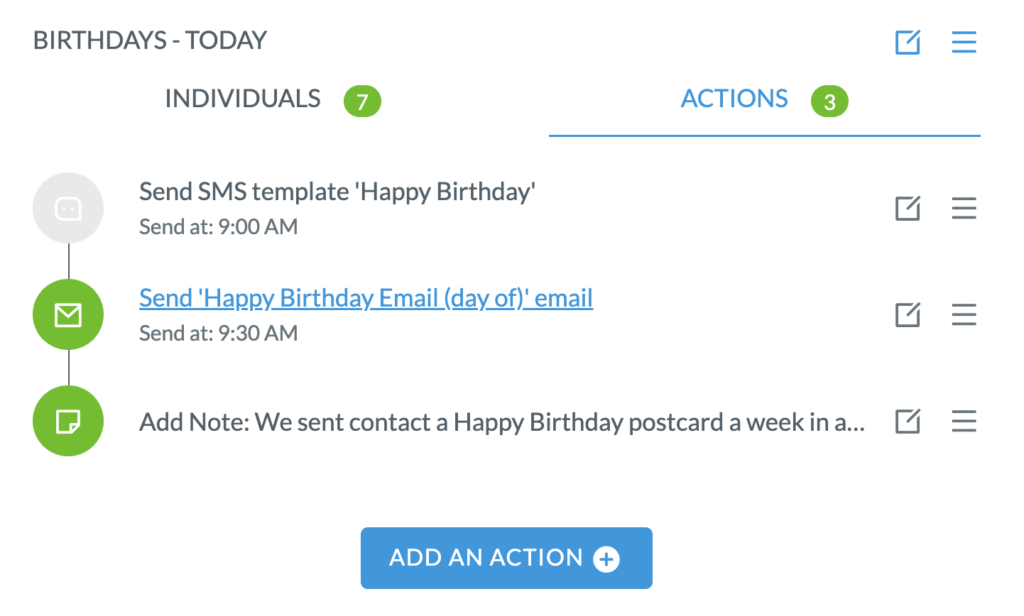
1. Find a Platform That Supports Automations
In fundraising, many of us are used to CRMs that basically just house a bunch of data. But when I worked in nonprofit, I really wanted a CRM that worked more like a fundraising engine…helping me build and execute a donor engagement plan without the manual work.
Birthday outreach is the perfect use case for automations because the sheer mass of sending birthday messages to all of your donors would eat up a significant amount of time. And, of all the automations to build, this one is fairly straightforward, which means it’s a great place to start.
So, your first step in building a birthday automation is having a platform designed to support relationship-building at scale with automation.
For my own case, I used birthday automations in Virtuous CRM+.
2. Use Built-In Templates
There’s no point in starting from scratch, as long as your platform has templates that can be customized and edited.
When I started building automations in Virtuous CRM+, I hadn’t even thought about sending birthday messages to our donors. But I saw it listed as one of the first examples, and I got inspired.
I didn’t just want to make a simple Happy Birthday automation with balloons and bubble letters. I wanted to use the automation to stand out, to help our donors feel appreciated, to go beyond all the other generic Birthday wishes to create something truly special.
And if I can do it, you can, too.
If you know how to wish someone happy birthday, you can set up birthday automations. Especially if you have an easy-to-use built-in template to support you.
3. Connect the Email to Your Nonprofit or Program
So, what do you say in a birthday automation email besides…happy birthday?
We used these automations as an opportunity to connect with our donors and give them an inside look at our nonprofit…specifically, how we celebrated birthdays.
For us, this meant making birthday cakes for every member of our recovery community. Often, 45 cakes a year or more. Needless to say, we shared lots of photos of cakes.
But also, we emphasized the impact donors’ gifts made on people in the recovery house by showing them a small way a sense of celebration was added to their lives.
Then, to really stand out, we used Virtuous CRM+’s email marketing tool to embed a YouTube video of our team singing Happy Birthday to our friends, our donors. Your staff, or your program leaders, could do something similar!
4. Add Letters on Demand
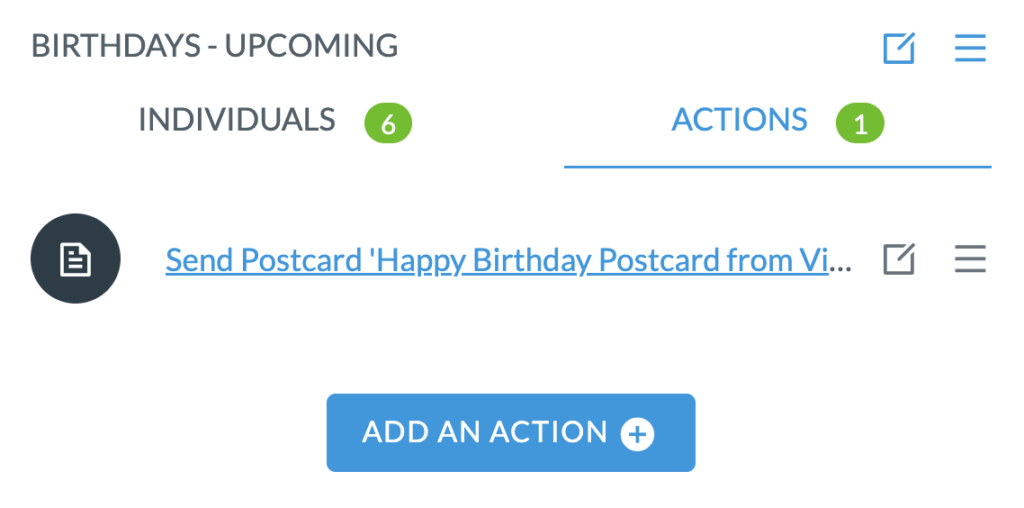
Most donor stewardship plans use multiple forms of media to reach donors.
So, once we had a handle on automated emails for birthdays, we started considering if there were other types of media we could add in.
So, using letters on demand through Virtuous CRM+, we started sending postcards, which added an even more personal element into the mix. We designed a postcard with pictures of our Birthday cakes on the front, and a quick tie-in to our program, plus wishing our friends Happy Birthday on the back.
Because who doesn’t love getting a birthday card in the mail?
With Virtuous CRM+, you can set up letters on demand and automate personalized letters and postcards without actually having to manually assemble the letters. It saves time while communicating responsively, in the way donors want to be communicated to.
5. Add SMS
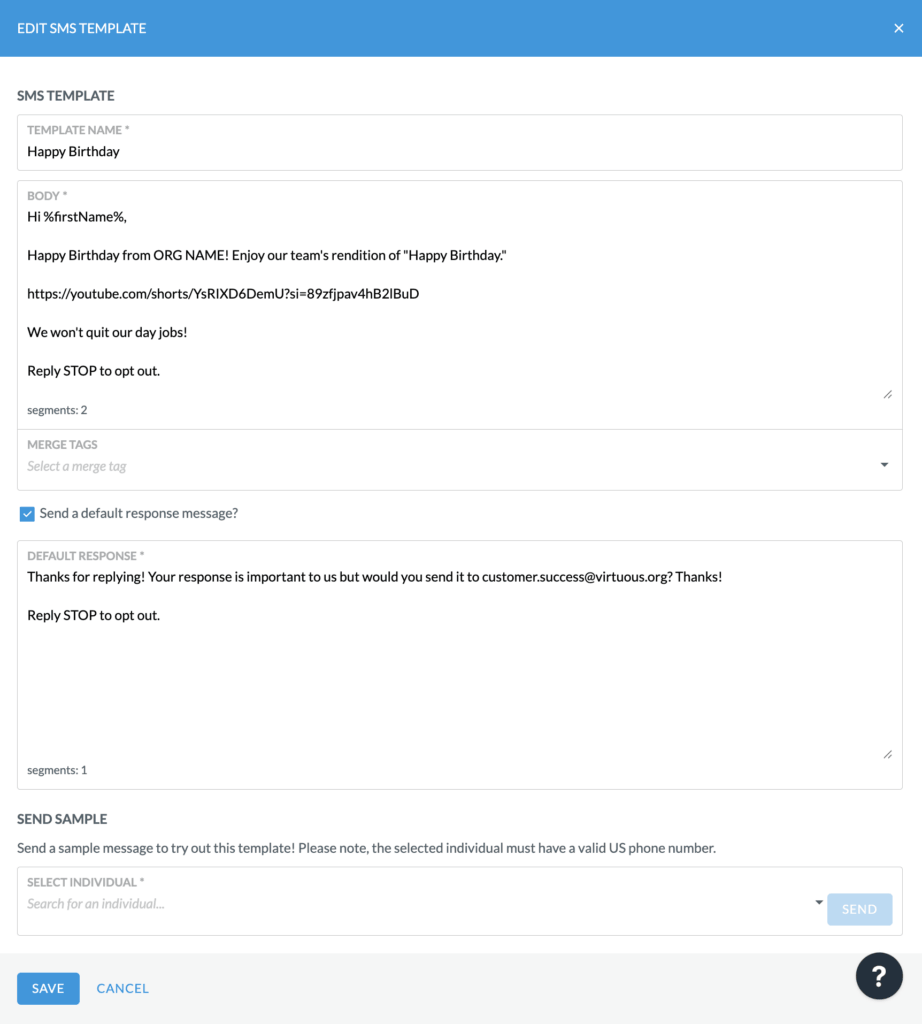
Once we truly committed to prioritizing birthday outreach, we wanted to make it more than just a simple automation, so we also added in a text message on the donor’s birthday.
There’s nothing like getting a slew of birthday texts on your day, and adding this touch can be a nice way to meet your donors where they are.
You might be asking: How do I differentiate this content from the email or the letter on demand?
And there are many ways you can handle this, but adding in another form of media can be a nice touch.
In the text, we added a link to a vertically filmed video of our whole staff singing happy birthday and thanking them for their contributions.
It felt awkward to film, but our donors loved it. It helped them feel seen on their birthday, and the video content made it unique compared to generic “Happy birthday” texts they might be receiving from other businesses.
Benefits of Adding Birthday Automations to Your Donor Stewardship Plan
When it comes to your donor stewardship plan, adding birthday automations boosts morale for both your team and your donors. Here are some benefits of adding these in:
Helping Donors Feel Seen
As fundraisers, we feel “seen” when a donor chooses to give to our mission. Especially these days, with so many other organizations vying for their attention.
Responsive fundraising means that our donors should also feel seen before, when, and after they give.
Acknowledging their humanity, their existence apart from being a donor, a day they celebrate…ultimately ends up inviting you into their personal world. And it helps your donors feel seen. And your nonprofit stand out in the crowd.
Building a Culture of Celebration at Your Nonprofit
As I mentioned, we loved celebrating birthdays at Providence Network. This celebration was already a part of our culture there.
But whether your nonprofit has a celebratory culture already…or is in need of some spirit-lifting…there’s no better way to boost this cultural piece than bringing donors into the mix.
It ended up being a meaningful way to share our internal festivities with the donors who support our cause. They felt invited into something, and donors associated us with this sense of community.
Timing Asks for Planned Giving & Legacy Giving
A hidden benefit of celebrating donor birthdays is that you…learn their birthdays.
Studies say we’re in the midst of a $10 trillion wealth transfer. If you want your mission to participate in that transfer, you need to know your donors’ birthdays.
When we get someone’s birthday into our system, we can begin to understand where they are in their life journey and what their current giving or volunteering capacity might be for our organizations. That helps us turn a one-time donation into a lifetime of partnership.
Along those lines, there are key moments in a donor’s life when it’s appropriate to ask the donor to consider planned giving or legacy giving.
You wouldn’t necessarily ask this of a college student involved in your organization…or maybe even a young family.
But determining the age of your donors can help you time those asks and make sure you have a full picture of where they are in their life journeys.
Pro Tip: If you don’t know your donors’ birthdays, Virtuous CRM+ offers data append services to help fill in the month and year of their birth (not the day). Or, as a Virtuous CRM+ expert suggested to me, you could build a parallel automation emailing your donors asking them to reply with their birthdays. Many did!
Ideas for Building Birthday Automations Into Your Donor Stewardship Plan
If you already have a donor stewardship plan in place, and you’re unsure how to implement this into your specific organization, here are a few ideas:
- If you’re an animal shelter, you can sub out the humans’ birthday messages in place of pet adoption day texts…or you can have both going.
- If you’re a pregnancy center, highlighting how new births are celebrated is an easy way to help your birthday automations connect back to your org.
- If you’re a homeless shelter, you can show how you celebrate the birthdays of the people you serve.
- If you’re a home-building org, you can show the first day a family walks into their new home and tie this into the birthday celebrations.
- If you’re a children’s health clinic, you can share how you’re celebrating birthdays of the children you serve.
If your org isn’t listed here, I hope you can still find ideas within this list. The possibilities here are endless.
Back Up Your Donor Stewardship Plan With a Fundraising Engine
Not every CRM is built for personalized outreach like this, and that’s why I recommend Virtuous CRM+.
As a fundraiser using Virtuous CRM+ for nearly three years, I appreciated Virtuous’s donor-first approach to fundraising, centering everything on building the donor relationship at scale.
As an employee of Virtuous, now I have the opportunity to share this even more directly with other nonprofits.
With Virtuous CRM+, you can set up birthday automations without starting from scratch. Use a template. Start with an email. If that goes well, add SMS and postcards. You can do it!
Want to see it in action?
Donor Stewardship Plan FAQs
What are some examples of stewardship strategies?
Some strategies to include in a donor stewardship plan are thank-yous after a gift, sharing the impact of their gifts, continued relationship cultivation, and well-timed upgrade asks.
What is a stewardship plan?
A stewardship plan in fundraising refers to how a nonprofit engages and cultivates relationships with their donors over time.
How to show appreciation to donors?
One of the best ways to show appreciation to your donors is to build in birthday automations to your donor stewardship plan. This adds a personal touch and shows that you view your donors as more than just a donor…but also as a person!
What are some examples of donor stewardship practices?
Donor stewardship plans can use many strategies or practices. Adding in personal contact points throughout your relationship with the donor is essential, such as birthdays, giving anniversaries, lifetime giving milestones, etc.